Bathroom Audio: Waterproof Speakers and Steam-Safe Systems
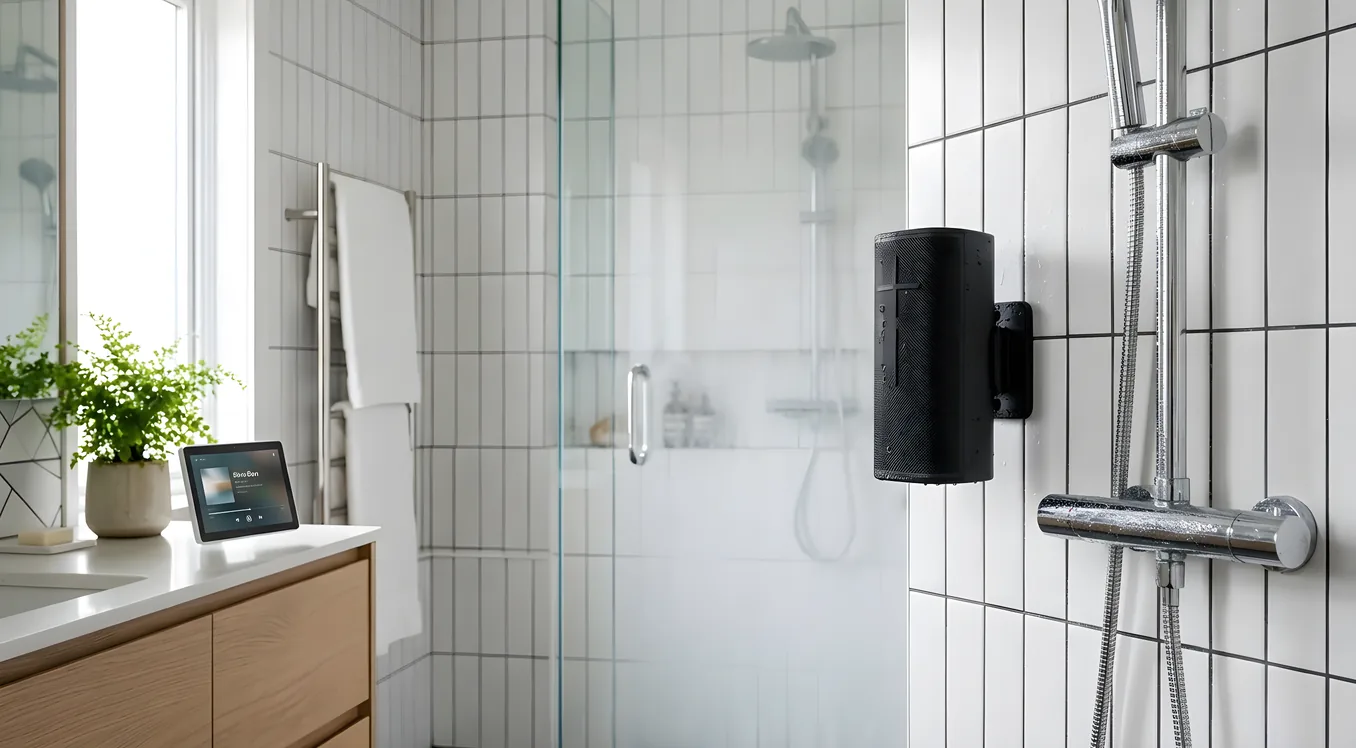
The bathroom is the room where audio matters most and gets the worst treatment. People spend 20 to 40 minutes a day in there, often with no other screen in sight, doing repetitive tasks that benefit enormously from something good to listen to. And yet most homes either skip bathroom audio entirely or toss in a Bluetooth speaker on the counter that gets knocked into the sink once every few months.
Getting bathroom audio right is a specific problem. Moisture, steam, and the confined acoustic space of a tiled room all require decisions that don’t apply elsewhere in the house. But done correctly, bathroom audio integrates cleanly into a whole-house audio system and becomes one of the more appreciated upgrades in any home.
Why Bathrooms Are Different From Every Other Room
The obvious answer is water. But the fuller answer is that bathrooms present three distinct environmental challenges that stack on top of each other.
Moisture and humidity. Even in a bathroom without a steam shower, daily use pushes relative humidity well above 80 percent regularly. Condensation forms on mirrors, walls, and any unprotected electronics. Standard speakers designed for indoor use are not rated for this environment, and even a few months of exposure can degrade drivers, corrode terminals, and cause early failure.
Steam. A steam shower takes humidity to a different level entirely. A properly enclosed steam shower reaches 100 to 115 degrees Fahrenheit with near-100 percent relative humidity during operation. Electronics that survive normal bathroom moisture may fail quickly in a steam enclosure if not specifically rated for it. This is not a minor distinction. Inside a steam shower requires a different category of product than just outside it.
Acoustics. Tile is acoustically brutal. Hard, parallel surfaces create significant flutter echo and comb filtering. Unlike a carpeted bedroom or a room with upholstered furniture, bathrooms have nothing to absorb reflected sound. This affects speaker placement and, frankly, speaker selection. Wide-dispersion drivers perform better in highly reflective spaces than narrow, focused designs.
These three factors together explain why bathroom audio is its own category with its own products, its own ratings systems, and its own installation considerations.
Understanding IP Ratings for Bathroom Speakers
IP ratings (Ingress Protection, per IEC standard 60529) are the primary specification to understand when selecting bathroom speakers. The rating appears as IP followed by two digits. The first digit rates protection against solid particles (dust, debris) on a scale of 0 to 6. The second rates protection against liquids on a scale of 0 to 8.
For bathroom applications, the second digit is what matters:
- IPX4: Protected against water splashing from any direction. Fine for areas away from direct water, like above a vanity or in a bathroom with no steam shower.
- IPX5: Protected against water jets. Suitable for most bathroom installations, including near a standard shower.
- IPX6: Protected against powerful water jets. Overkill for most residential bathrooms but found in some commercial-grade products.
- IPX7: Submersion up to 1 meter for 30 minutes. Marketed heavily for bathrooms but not necessarily better than IPX5 for actual use cases.
- IPX8: Continuous submersion beyond 1 meter. Relevant for pool and marine applications, not residential bathrooms.
For steam showers specifically, IPX4 or IPX5 alone is not sufficient. Steam creates a different penetration problem than liquid water splashing. Products designed for steam enclosures typically carry a specific “steam room” rating from the manufacturer, tested at elevated temperatures and sustained humidity. Look for this explicit designation rather than relying on IP ratings alone.
The most commonly cited products for in-shower or steam-adjacent use include the Polk Audio SR Series, Klipsch AW Series (surface-mount), and in the higher-performance tier, the Sonance Marine Series. Sonance MA Series speakers are rated at IP65 and carry specific approval for steam room installation, which makes them a go-to for integrators building steam shower audio.
In-Ceiling vs Surface-Mount: What to Use Where
In-Ceiling Speakers for Bathrooms
In-ceiling speakers are the cleanest-looking installation and the default choice for bathroom audio when there’s accessible attic space or a second floor above. They disappear into the ceiling, require only a round or rectangular cutout, and direct sound downward into the room.
The installation concern for bathrooms is the back can. Standard in-ceiling speakers are open-backed, meaning the driver housing opens into whatever cavity is behind the ceiling. In a bathroom installation, moisture that gets past the speaker grille needs somewhere to go, and an open-back design lets it migrate into insulation or structural framing. Specifying a back-can enclosure or a closed-back design prevents this. Several manufacturers offer their bathroom-rated speakers with sealed rear enclosures specifically for moisture isolation.
Klipsch makes the CDT-3650-C II (around $130 each), a common choice for living rooms, but for bathrooms their in-ceiling options with proper moisture resistance cost $200 to $350 per speaker. Polk Audio’s 70-RT and similar bathroom-rated designs run $100 to $180 each and are a common mid-range choice for integrators who want a reliable, proven performer without premium pricing.
For higher-end installations where sound quality in the bathroom receives the same attention as the main listening room, Sonance and Origin Acoustics make in-ceiling speakers rated for humid environments at price points from $400 to $900 per speaker. At that tier, the acoustic performance is genuinely excellent, even in a reflective tile environment.
Surface-Mount Speakers for Steam Environments
Inside a steam enclosure, in-ceiling speakers are essentially off the table unless the ceiling penetration can be completely sealed, which defeats most installations. Surface-mount speakers designed for steam rooms solve this by mounting to the wall or ceiling surface with a sealed housing that contains everything.
The Polk Audio Atrium 4 ($50 to $60 per pair) and similar outdoor-rated speakers get used in steam rooms by contractors who need something budget-friendly, but they’re not specifically steam-rated and may not hold up long-term. True steam room products include the Kohler Soundtile, a speaker built directly into a tile form factor that mounts like any other tile ($500 to $800 per unit). It’s niche, it requires AV and tile work to coordinate during installation, but it’s genuinely elegant when it works.
For high-end steam rooms, integrators often turn to the Speakercraft OE6 or similar outdoor-rated speakers mounted just outside the enclosure, positioned to project sound through a small opening, rather than placing audio components inside the steam environment at all. This is a reasonable compromise when the cost of true steam-rated components is difficult to justify.
Amplification and Source: Where the Audio Comes From
The speaker is only half the equation. Bathroom audio needs a source and amplification, and the options here are more varied than the speaker selection.
Sonos Amp as a Zone Driver
The Sonos Amp ($699) is the most common way to add passive bathroom speakers to a streaming ecosystem. It delivers 125 watts per channel into 8-ohm loads, handles up to four passive speakers in a zone, and integrates with the Sonos app for multi-room control. If the home already runs Sonos for other zones, adding a bathroom zone with a Sonos Amp and a pair of in-ceiling speakers is straightforward and keeps everything in one app.
The Sonos Amp sits outside the bathroom (in a nearby closet, above the ceiling in adjacent attic space, or in a central AV rack) and runs speaker wire to the in-ceiling drivers. This keeps all electronics away from the moisture environment. Only passive speakers with rated wire terminals occupy the bathroom itself.
In-Ceiling Speakers with Integrated Amplification
Some bathroom-rated in-ceiling speakers include integrated amplification and Wi-Fi or Bluetooth connectivity, eliminating the need for a separate amp. The Klipsch Reference series and several models from Polk Audio’s streaming line work this way. The appeal is simpler installation, especially in retrofit situations where running wire to a central amp isn’t feasible.
The tradeoffs are real, though. Integrated electronics inside the speaker housing are exposed to more moisture than a remote amp. Multi-room synchronization is harder to achieve with integrated-amp speakers than with a centralized amplification platform. And if the amp module fails, the entire speaker typically needs replacement.
Custom Integration: Control4 and Crestron Platforms
For homes with Control4 ($3,000 to $20,000+ for the full system) or Crestron automation, bathroom audio becomes a zone in the larger whole-home matrix. The bathroom touchpanel or keypad (often a simple two-button volume control or a small touchscreen) controls the zone through the same interface as every other room.
Control4’s EA series controllers handle audio zone management, and integrators typically combine them with Triad Audio amplifiers (Control4’s in-house amp brand) or third-party multi-channel amps like Crown or QSC for larger installations. Sonance speakers are a common pairing at this tier.
For homeowners researching how bathroom audio fits into a larger audio-video installation, the short answer is that wired systems integrated into a control platform deliver significantly better reliability and performance than self-contained wireless solutions, at a substantially higher upfront cost. The wireless solutions are faster to install and often sufficient for music listening, but they don’t perform as consistently as part of a coordinated system.
Practical Costs: What to Budget
Bathroom audio spans an enormous price range depending on installation type and product tier.
Entry level (retrofit, wireless): A pair of Bluetooth or Wi-Fi speakers designed for bathroom use, like the Bose SoundLink Flex (IPX7, $149) used in shower proximity, or a single self-powered in-ceiling unit, runs $150 to $400 total. This requires no electrician and minimal installation.
Mid-range (wired in-ceiling, Sonos-driven): A pair of in-ceiling bathroom-rated speakers at $200 to $350 each, a Sonos Amp at $699, and installation labor of $300 to $600 puts the total at $1,400 to $2,000 per bathroom. This is the most common option in new construction and whole-home audio projects.
High-end (steam-rated, integrated control): Premium speakers rated for steam environments ($500 to $900 each), Control4 or Crestron zone integration, and a custom amplification setup can run $3,000 to $8,000 per bathroom when included in a full home automation project. The cost is less about the speakers themselves and more about the control infrastructure.
Steam shower audio specifically: Expect to add $1,500 to $4,000 to any steam shower project for audio that’s genuinely rated for the environment, properly installed, and integrated into the broader system.
Labor costs vary by region. In major metro areas, AV labor typically runs $85 to $150 per hour. Electrician work for dedicated circuits (occasionally needed for higher-draw amplification) adds another $75 to $125 per hour.
Placement Matters More Than Most Homeowners Realize
Tile-heavy rooms with parallel walls create acoustic problems that speaker placement can partially address. The goal is to minimize direct reflections between parallel surfaces while maintaining even coverage throughout the room.
Avoid center ceiling placement in rectangular bathrooms. A speaker in the exact center of the ceiling creates equal path lengths to all four walls, which reinforces comb filtering. Offset the speaker toward the shower or tub side by 18 to 24 inches.
For stereo pairs: Place two speakers on opposite sides of the room’s long axis, angled slightly toward the center. In a typical 8x10-foot master bath, that means one speaker over the vanity area and one over the shower or tub, each aimed slightly inward.
Toe-in matters for wide-dispersion drivers: In-ceiling speakers with pivoting tweeters (common in better bathroom-rated models) should be aimed toward the primary listening position, usually the shower or tub, not straight down.
Avoid proximity to exhaust fans: Placing a speaker adjacent to an exhaust fan creates a background noise floor that competes with the audio at low listening levels. Keep speakers at least 24 inches from fan openings.
Integration with Smart Home Systems
Bathroom audio that operates as a standalone Bluetooth speaker is a product. Bathroom audio that responds to your morning routine is a feature.
In a Control4 or Crestron environment, bathroom audio typically connects to occupancy and time-of-day logic. The bathroom light comes on, the audio zone activates and begins playing whatever was last selected, volume scales with a default level. Leaving the bathroom triggers the zone to fade and turn off. This requires either occupancy sensing (a PIR sensor in the bathroom, which is standard in higher-end smart home builds) or a button press, depending on how precisely the homeowner wants the automation to behave.
Sonos users get a version of this through third-party platforms. SmartThings, Amazon Alexa routines, and Apple Home automations can all trigger a Sonos zone based on occupancy, time, or another condition. It’s less precise than a dedicated control system, but it works and it’s accessible to homeowners who aren’t investing in a full automation platform.
For homes exploring how bathroom audio fits into in-ceiling speaker systems more broadly, the bathroom zone typically represents one of the smaller and simpler zones to configure, but one of the most frequently used.
What to Avoid
A few patterns come up repeatedly in bathroom audio installations that end in dissatisfaction or failure.
Standard indoor speakers in bathroom environments. Even “moisture resistant” claims from generic brands rarely reflect real testing. A speaker that survives one steam shower session may fail in three months under daily use. Specify IP-rated products with explicit humidity ratings.
Wireless speakers inside steam enclosures. Bluetooth and Wi-Fi signals degrade with metal-lined steam enclosures. Physical obstructions and reflective surfaces create connectivity problems that a wireless speaker inside or immediately adjacent to a steam shower will encounter regularly. Wired passive speakers with the amplifier outside the enclosure are significantly more reliable.
Undersized wire runs. Speaker wire for bathroom applications should account for the routing path, which is often longer than expected in retrofit installations. Use 16 AWG minimum for runs under 50 feet, 14 AWG for longer runs. Undersized wire reduces damping factor and can affect bass response noticeably.
No volume limiting on shared zones. In households with varying sleep schedules, a bathroom zone that shares a volume level with a bedroom zone will annoy someone regularly. Configure bathroom zones with their own independent volume control, even if the source is shared.
Getting the Installation Right
Bathroom audio is best addressed during new construction or a major renovation for exactly the same reason as bathroom radiant floor heating: the infrastructure is trivially easy to add during framing and catastrophically difficult to retrofit after tile is set.
During a bathroom renovation, the marginal cost of running speaker wire and conduit before drywall and tile is $100 to $300. The cost of a retrofit installation in an existing finished bathroom can be $500 to $1,500 in labor alone, depending on attic access and wall configuration.
If you’re working with an integrator on a whole-house audio project, request that bathroom zones be included in the initial conduit and wire run, even if you don’t activate them immediately. The hardware can always be added later. The wire cannot be added later without opening walls.
The same principle applies to steam showers specifically: specify audio rough-in during the steam room construction phase. Any competent steam room contractor will accommodate it; most won’t suggest it unless asked.
Choosing the Right System for Your Situation
The practical decision tree for most homeowners breaks down cleanly:
If you’re adding audio to an existing bathroom without opening walls, a Sonos Era 100 on a shelf or a Wi-Fi-enabled self-powered in-ceiling unit is the realistic option. Budget $300 to $600, accept some connectivity variability, and move on.
If you’re renovating a bathroom or building new and want integrated in-ceiling audio, specify bathroom-rated in-ceiling speakers, run 14 AWG wire to a central location, and pair with a Sonos Amp or equivalent. Budget $1,200 to $2,500 depending on speaker tier.
If you have a steam shower and want audio inside or immediately adjacent to it, work with an integrator who has specifically done steam room audio before. Specify steam-rated products or design the system to keep all electronics outside the enclosure. Budget $2,000 to $5,000 for the audio portion alone.
If you’re building a fully automated home, include bathroom audio zones in the initial AV design. Control4 and Crestron integrators handle this routinely and the per-zone cost in a full-home project is significantly lower than adding zones later.
Audio that sounds good in a bright, tiled, reverberant room requires specific products installed correctly. But the result, a morning shower with actually good sound that fades when you leave, is one of the small daily experiences that makes a well-designed smart home noticeable in the best way.