Outdoor Audio and Video: Weatherproof Entertainment Systems
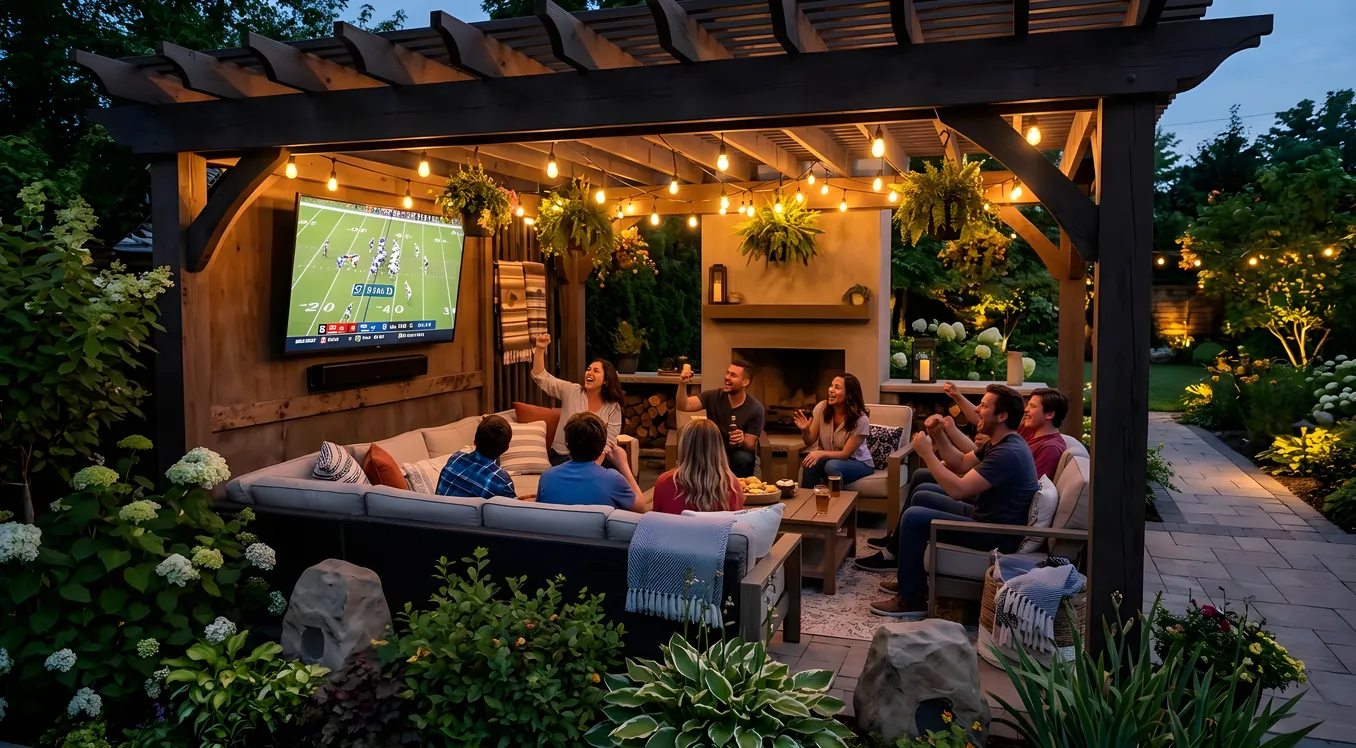
Your patio gets used roughly three seasons a year. A properly designed outdoor audio video system makes those seasons significantly more enjoyable, and a poorly designed one becomes an expensive lesson in what “weatherproof” actually means on a spec sheet versus in a rainstorm. The gap between those two outcomes comes down to component selection, placement, and how the system ties into your home’s broader control infrastructure.
This isn’t a quick overview of Bluetooth speakers and portable projectors. If you want a system that handles weather, sounds genuinely good, works with the rest of your smart home, and doesn’t need to be disassembled every October, the decisions here require some depth.
Why Outdoor AV Is Harder Than Indoor AV
The fundamental challenge with outdoor audio and video is that you’re designing for an environment that actively tries to destroy electronics. Temperature swings from 20°F to 110°F, UV radiation, humidity, rain, insects, salt air near the coast, dust in drier climates. Components rated for indoor use fail within a season or two under these conditions.
Speaker cones warp when waterlogged and won’t return to spec even after drying. Tweeter surrounds crack under UV exposure. Display screens develop condensation behind the panel glass when temperature differentials exceed roughly 25°F. Electronics without proper conformal coating corrode from the inside out in humid climates.
The solution isn’t waterproof cases and hoping for the best. It’s using components purpose-built for outdoor environments, with ratings and construction that actually match your climate.
IP and Ingress Protection Ratings: What They Mean for Your System
Before evaluating any outdoor AV component, understand IP ratings. The “IP” stands for Ingress Protection, and the two-digit code tells you how well a device resists solids and liquids.
The first digit (0-6) rates dust and solid particle resistance. IP6X means fully dust-tight. The second digit (0-9K) rates water resistance. IPX4 handles splashing water from any direction. IPX5 handles water jets. IPX6 handles powerful jets. IPX7 means temporary submersion to 1 meter. IPX8 means continuous submersion beyond 1 meter.
For outdoor audio speakers, look for a minimum of IP55: fully dust-protected and resistant to water jets from any direction. Most quality outdoor landscape speakers from Sonance, Polk Audio Atrium series, Klipsch AWR series, or James Loudspeaker meet this threshold. For components in truly wet locations, pool surrounds or areas under rain-exposed eaves without any overhang coverage, IP65 or better is the more appropriate baseline.
For outdoor displays, ratings matter even more because a failed screen is a significantly larger financial loss than a failed speaker. The difference between an outdoor-rated display and a consumer TV that happened to be moved outside will become clear the first time dew forms on a cool morning after a warm evening, or when direct sun raises ambient temperatures past 100°F.
Outdoor Speakers: The Landscape and Surface-Mount Ecosystem
Outdoor audio divides into roughly three categories based on how speakers integrate with the space: landscape speakers buried or staked near ground level, surface-mount speakers attached to structural surfaces, and architectural outdoor speakers that blend into the home’s exterior.
Landscape and Rock Speakers
Landscape speakers sit low in garden beds, along walkways, or near pool surrounds. Rock-style speakers, designed to look like natural boulders, are the most common form factor. Klipsch AW-650 outdoor speakers ($200-$250 per pair) use a 6.5-inch woofer and 1-inch tweeter in an all-weather ABS enclosure, rated IPX5. They blend reasonably well into plantings when positioned thoughtfully.
The advantage of landscape placement is audio coverage without visible equipment. A ring of four landscape speakers around a pool provides surround coverage without any speakers mounted on the house structure. The disadvantage is that ground-level speakers have less output headroom than elevated surface-mount speakers, which can be a problem for large open areas or when competing with pool equipment noise.
Speaker placement for landscape systems should follow the same fundamentals as any distributed audio layout. Aim for coverage overlap of roughly 30-40% between adjacent speakers to avoid hot spots and dead zones. For a 30-by-50-foot pool area, four speakers spaced 25 feet apart typically provides more even coverage than two large speakers at either end. If you’re connecting this to a whole-house audio system, keep outdoor zones on dedicated amplifier channels rather than paralleling outdoor speakers with interior zones.
Surface-Mount Speakers
Surface-mount outdoor speakers attach to walls, soffits, pergola structures, or dedicated poles. This category spans a wide range, from basic $80-per-pair units designed for casual use to serious high-output systems.
Sonance Outdoor series speakers represent the upper-middle tier commonly specified by custom integrators. The Sonance PS-S83T ($600-$800 per pair) is an 8-inch, 3-way surface-mount speaker with 100V/70V transformer options that integrate cleanly with distributed audio systems. For covered patio applications with a ceiling or soffit mounting option, Sonance also makes a weatherproof version of their in-ceiling form factor under the Sonance Outdoor line.
At the top end, companies like James Loudspeaker and Atlantic Technology produce surface-mount outdoor speakers that approach high-end indoor performance. The James Loudspeaker EMB-8 ($2,800 per pair) uses the same driver quality as the company’s indoor architectural speakers in a fully weatherized enclosure. These aren’t aspirational products for most homeowners, but they set the ceiling for what outdoor audio can actually sound like.
Polk Audio’s Atrium series occupies the practical middle ground. The Atrium 8 SDI ($180-$220 per pair) uses a 8-inch woofer and 1-inch tweeter with IP55 rating in an ABS enclosure that comes in both white and black finishes. It’s a dependable, widely available option that sounds good for its price point.
Subwoofer Considerations
Many homeowners assume outdoor audio doesn’t need dedicated bass reinforcement because open space dissipates low frequencies less perceptibly. The opposite is true: outdoor environments eat low-frequency content aggressively because there are no walls to create pressure buildup. A full-range outdoor system that sounds thin is almost always a subwoofer problem.
Outdoor subwoofers designed for below-grade installation, like the Polk Audio Atrium Sub 10 ($500-$600) or the Sonance SUB8 ($900), can be buried in landscape beds with only a small grille visible. Above-grade options that integrate with a pergola or equipment area include the SpeakerCraft OE-SUB10 ($1,200-$1,500).
Budget guidance: plan on at least one outdoor subwoofer for every 600-800 square feet of outdoor entertainment space. Larger open areas benefit from two positioned at opposite ends.
Outdoor Video: Screen Technology and Placement
Outdoor displays require the clearest thinking of any component decision in an outdoor AV system. The landscape here divides into three distinct categories: outdoor-rated commercial displays, outdoor-rated residential displays, and consumer television panels in weather enclosures.
Outdoor-Rated Residential Displays
Manufacturers including SunBrite (acquired by Core Brands), Séura, and Peerless-AV make displays specifically engineered for residential outdoor use. These aren’t consumer panels in weatherized housings. They use high-brightness panels (typically 1,000-4,000 nits versus the 400-600 nits of a standard consumer television), sealed enclosures with optical glass that resists condensation, and thermal management systems that allow operation in temperatures from -22°F to 122°F.
The SunBrite Pro 2 series is the most widely specified in residential outdoor AV. The 75-inch SB-P2-75-4K-BL runs approximately $4,500-$5,500. The panel produces 1,500 nits of brightness, which is enough for covered patio use even on sunny afternoons. Full-sun installations (south-facing mounting with no overhead cover) typically require SunBrite’s 3,000-nit Signature series, which adds $1,500-$2,500 to the price point.
Séura’s Storm series targets high-end residential installations. The 65-inch Séura Storm 4K ($6,800-$8,200) offers 4K HDR, full waterproofing to IP66, and a higher-brightness panel than SunBrite’s mid-tier. Séura also produces a TV Mirror line that transitions from a mirror to a display when powered on, which solves the aesthetic problem of a black rectangle dominating an outdoor space.
Critical Placement Decisions
Where you put an outdoor display matters as much as which display you choose. Three rules govern practical placement:
Avoid direct east or west morning/evening sun exposure. Even a 3,000-nit display looks washed out in direct sunlight from low angles. Structure, landscaping, or a pergola roof above the mounting location solves this.
Plan cable management before installation. Outdoor displays need power (dedicated 20A circuit minimum for large panels), HDMI or video signal from a source, control system wiring if the display integrates with Control4, Savant, or Crestron, and potentially a conduit chase for future additions. Running all of this through a finished outdoor structure after the fact is expensive and often ugly.
Consider the viewing angle relative to seating. Outdoor seating arrangements rarely form the neat rows that indoor media rooms permit. For pool areas especially, figure out where people actually sit, stand, and gather, then locate the display where sight lines work for the realistic use case rather than the idealized rendering.
System Integration: Making Outdoor AV Part of the Home
An isolated outdoor AV setup that runs on its own Bluetooth speaker and a television remote is far less functional than an outdoor zone integrated with your home’s audio and control systems. The difference is practical convenience: one button or voice command to set the outdoor scene versus fiddling with three separate devices.
If your home already uses a platform like Control4, Savant, or Crestron, outdoor AV zones extend into that ecosystem naturally. Control4’s ecosystem, for example, treats outdoor audio zones identically to interior zones within the distributed audio architecture. Outdoor speakers connect to the same matrix amplifier (Control4’s CA-4, CA-10, or CA-12 amplifiers at $700-$2,500) and appear as named zones in the touchpanel or Control4 app. The outdoor display connects as a named input in the video distribution matrix. Scene programming can simultaneously turn on outdoor audio at a set volume, activate the display, set outdoor lighting through Lutron Caseta or RadioRA3, and trigger a motorized screen to deploy.
Sonos is the more common starting point for homeowners without an existing custom installation. The Sonos Amp ($699) drives a pair of outdoor passive speakers while integrating with the Sonos app and any platform (Google Home, Amazon Alexa, Apple HomeKit via AirPlay 2) the homeowner already uses. It’s not the highest performance path, but it’s reliable, updatable, and doesn’t require a programming appointment. For a detailed comparison of when Sonos makes sense versus custom audio, see our breakdown of Sonos versus custom-installed audio.
For homeowners who want to share a single video source across both indoor and outdoor displays (watching the same game from the patio that’s showing on the great room TV, for example), that requires either a video distribution system or HDMI over IP. Atlona, Wyrestorm, and Binary Video Solutions offer HDMI-over-Cat6 extenders that can route a 4K signal from a central equipment rack to an outdoor display over 100+ feet of Cat6 cable. The AT-HDVS-TX-WP from Atlona ($350-$400) is a wall-plate transmitter that pairs with a receiver at the display end. This integrates cleanly into any distributed video architecture the home already uses.
Outdoor AV Without Existing Infrastructure
Not every outdoor AV project starts from a whole-home system foundation. A significant number of homeowners want to add outdoor audio and video to an existing house where indoor AV was never structured for distribution.
In these cases, the practical path is usually a Sonos Amp driving outdoor speakers, paired with a cellular or Wi-Fi connected outdoor display, all managed through smart speakers or a phone app. The limitation is that this approach creates a silo: the outdoor system doesn’t know what the rest of the home is doing and can’t be coordinated through a single interface that also controls lighting, HVAC, and security.
Adding a modest control layer solves this without requiring a full Control4 or Crestron installation. Brilliant’s smart home platform, or even a Lutron Caseta switch with Pico remotes paired to a Sonos system, can give useful one-button coordination for outdoor scenes at a fraction of the cost of a full custom installation.
If this is the moment you’re deciding whether to invest in infrastructure for your outdoor space, the cable is almost always worth running during any construction or landscape project. Conduit for future cable runs, speaker wire pre-terminated in a weatherproof junction box, a dedicated 20A circuit for a future display, all of these cost a fraction of what they’ll cost to retrofit later.
Weatherproofing and Maintenance Realities
A common misconception about outdoor AV systems is that “weatherproof” means maintenance-free. It doesn’t.
Speaker grilles collect debris and need periodic cleaning (compressed air, soft brush) to maintain acoustic performance. Display screens accumulate dust, pollen, and salt film in coastal areas; clean only with manufacturer-approved screen-safe solutions. Wiring connections at outdoor enclosures should be inspected annually for corrosion, particularly in humid climates or near salt air.
Sealed enclosures may accumulate condensation if installation wasn’t done correctly. Desiccant packs inside speaker enclosures should be replaced annually in humid climates. Check with the manufacturer or your integrator on the specific schedule for any equipment you have installed.
Equipment that isn’t designed for the specific stresses of your climate will fail faster than specs suggest. Coastal California, Florida, and Gulf Coast installations face salt air corrosion. Mountain installations face UV at elevation. Arizona installations face sustained heat that exceeds the operating range of many components rated for “outdoor” use in temperate climates.
Budget Framework for Outdoor AV
Rough cost ranges by system tier for a typical covered patio of 400-600 square feet:
Entry tier ($1,500-$4,000): Four surface-mount or landscape speakers, Sonos Amp, no display. Sufficient for background music and casual listening. Sonos integration for app and voice control.
Mid-tier ($5,000-$12,000): Six to eight speakers with a subwoofer, Sonos Amp or mid-range distributed audio system integration, 65-inch outdoor-rated display (SunBrite Pro 2 or similar), basic wiring management. Professional installation included.
Full integration tier ($15,000-$40,000+): High-output landscape or architectural speakers from Sonance or James Loudspeaker, subwoofer, complete integration into Control4, Savant, or Crestron home automation platform, outdoor-rated display in the 75-85 inch range from SunBrite Signature or Séura, motorized shade for display protection, outdoor lighting scene coordination, professional programming.
These ranges assume covered patio installation. Full-sun installations requiring higher-brightness displays add $2,000-$4,000 to the display line item. Pool perimeter surround speaker systems add $3,000-$8,000 depending on speaker count and integration complexity.
Getting Outdoor AV Right the First Time
The most predictable way to end up with an outdoor AV system that actually gets used is to hire an integrator who has done a significant number of outdoor installations specifically, not just indoor custom work. Outdoor AV has enough failure modes (cable failure, component corrosion, display condensation, surround sound EQ challenges in open spaces) that experience with those specific failure modes matters.
Ask to see finished outdoor projects. Ask what brand of outdoor display they specify and why. Ask about their warranty and service procedures for outdoor equipment failures. An integrator who has been through a SunBrite display developing condensation behind the panel, or who has debugged a distributed audio system where outdoor weather affected speaker impedance readings, will give you a very different installation than one who is applying indoor assumptions to an outdoor setting.
For homeowners who have invested in a broader smart home platform, outdoor entertainment is one of the highest-visibility payoffs on that investment. A well-executed outdoor AV zone, where one tap on a Control4 touchpanel or a single voice command to a Google Nest device starts music at the right volume, turns on the display, and sets the patio lights to the right scene, makes the entire home system feel more functional.
Building a System That Ages Well
The best outdoor audio video systems age gracefully because they were built around infrastructure, not just products. Wire conduit that allows future cable replacement. Amplifier locations in protected, temperature-controlled spaces rather than in direct weather exposure. Display mounts rated for heavier panels than what’s currently installed. Speaker pre-wire in landscape areas even where speakers aren’t yet planned.
This forward-looking approach applies to the control side too. A system integrated into Control4 or Crestron can add outdoor cameras, access control, and additional entertainment zones without tearing out infrastructure. A Sonos system can expand by adding new Sonos Amp units. The platform you choose shapes what’s possible later.
The homeowners who get the most out of outdoor AV are the ones who planned for how they actually live outdoors, not how they imagine they might. If you host large gatherings, you need more speaker coverage than you think. If you spend quiet evenings with a couple of people, a large display at high volume creates an odd experience. Match the system to realistic use patterns, build the infrastructure to handle that, and the outdoor space becomes genuinely more livable for years.