Pool and Spa Automation: Temperature, Chemistry, and Control
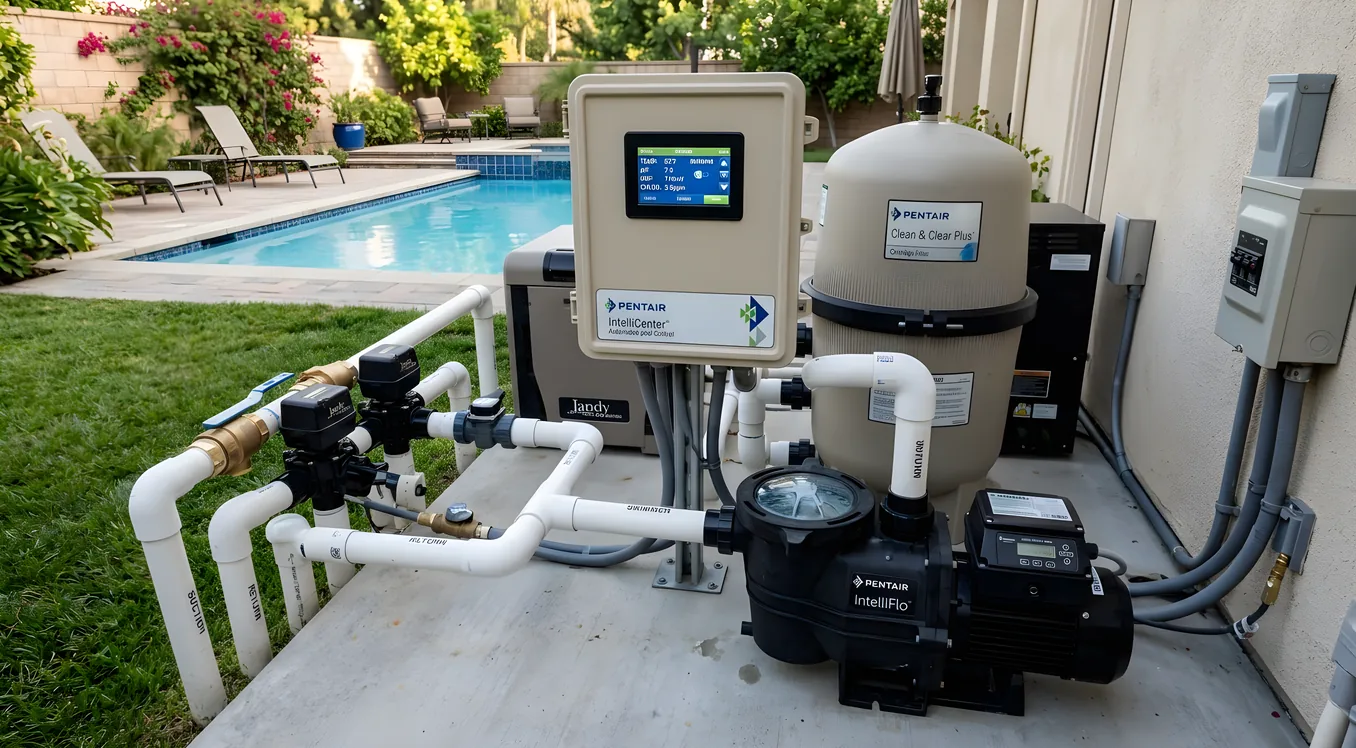
Pool ownership comes with a recurring promise that almost never delivers: you’ll spend 15 minutes a week maintaining it, and the rest of the time you’ll just enjoy it. In practice, most pool owners spend far more time than that testing water, adjusting equipment timers, and second-guessing whether the pump ran long enough. Smart pool automation doesn’t eliminate pool maintenance, but done right, it compresses the routine stuff to a few minutes of app-checking rather than hours of guesswork.
This is not about novelty. It’s about whether your $1,500 pool heater starts two hours before you get home on Friday rather than the moment you jump in, whether your salt cell chlorinator adjusts automatically when the weather hits 100 degrees, and whether you get a phone alert before an equipment failure turns into a $4,000 repair bill. The technology to do all of that exists, it works, and the entry point is lower than most pool owners expect.
What Smart Pool Automation Actually Controls
The term “pool automation” covers a wide range of equipment, and it’s worth understanding what each piece does before evaluating whether you need it.
Pump control is the foundation. Variable-speed pumps, which are now required by law in many states for new pool installations, can be scheduled and speed-adjusted remotely. A Pentair IntelliFlo3 VSF pump (around $1,100 to $1,400 installed) or a Hayward TriStar VS 900 (around $900 to $1,200) can be integrated into an automation system that runs the pump at low speed for filtration during off-peak hours, ramps up for cleaning cycles, and cuts speed at night. This alone can reduce pump operating costs by 50 to 80 percent compared to single-speed pumps running full bore.
Heating control covers gas heaters, heat pumps, and solar heating systems. Being able to set a target temperature from your phone, schedule heat-up times, and monitor actual water temperature in real time is genuinely useful. If you have a gas heater like a Pentair MasterTemp 400 BTU or a Hayward H400FDP, connecting it to an automation system means you stop running it when nobody’s swimming and start it at the right time before someone does.
Chemistry monitoring and dosing is where smart pool automation has made its biggest leap in the last five years. Traditional pool chemistry meant buying a test kit or strips, dipping, reading, calculating, and manually adding chemicals. Automated chemical systems like the Pentair IntelliChem Controller ($600 to $900 for the controller plus installation) or the Hayward Sense and Dispense system continuously monitor pH and ORP (oxidation-reduction potential, which correlates to sanitizer effectiveness), then automatically dose the pool with acid and liquid chlorine or trigger a salt cell to produce more chlorine. The result is water that stays in balance around the clock rather than spiking after a pool party and crashing during a heat wave.
Lighting control for pools has improved dramatically with LED technology. Pentair IntelliBrite 5G, Hayward ColorLogic 4.0, and Jandy WaterColors lights replace single-color incandescent fixtures with full-color LED systems that can be set to specific colors, synced to schedules, or triggered from automation scenes. The Pentair IntelliBrite 5G runs about $350 to $500 per fixture plus installation.
Water features including waterfalls, deck jets, bubblers, and fountains are typically plumbed with dedicated valves that can be actuated remotely. Actuators like the Pentair IntelliValve (around $200 to $350 each) allow the automation system to redirect water flow to different features on command.
Spa jets and blowers are often tied into pool automation systems. A dedicated spa mode can automatically set valves, raise temperature, run the blower, and switch lighting to a spa-specific scene with a single button or app command.
The Main Automation Platforms: Pentair, Hayward, and Jandy
Three manufacturers dominate residential pool automation equipment: Pentair, Hayward, and Jandy (owned by Fluidra). All three offer complete automation ecosystems, and most pool equipment installers work primarily with one of these lines. Mixing brands creates integration headaches, so if you’re starting fresh or adding automation to an existing pool, matching your automation controller to your equipment brand usually results in fewer problems.
Pentair IntelliCenter is the current flagship controller from Pentair. The IntelliCenter 8 ($1,800 to $2,500 for the panel before installation) can manage up to eight features, including pumps, heaters, chemical controllers, and actuated valves. It connects to Wi-Fi and integrates with the Pentair Home app, which provides remote control, scheduling, and monitoring from any smartphone. The IntelliCenter also supports Alexa and Google Home voice control for basic commands.
For larger installations, the IntelliCenter 16 handles up to 16 features. Installation on a new pool or a pool without existing automation runs $800 to $1,500 in labor depending on the complexity of existing equipment and local electrician rates.
Hayward OmniLogic is Hayward’s competing platform and is generally considered the strongest competitor to Pentair’s IntelliCenter in terms of feature depth and app quality. The OmniLogic supports up to 40 features in a single system. Hayward’s app interface is clean, scheduling is flexible, and the integration with Hayward ColorLogic lighting is seamless. An OmniLogic starter package runs $1,400 to $2,000 for the controller and hub, plus $1,000 to $1,500 in installation labor for a typical residential setup.
Jandy iAquaLink is Jandy’s web-connected pool control system. The iAquaLink controller integrates with Jandy’s pump and chemistry equipment and supports Amazon Alexa. It tends to be the less expensive entry point among the three, with systems starting around $800 to $1,200 for the controller, and Jandy offers a 2.0 version with improved Wi-Fi range and a redesigned app.
If your pool was built or recently equipped by a single-brand contractor, you’re likely already in one of these ecosystems. Compatibility guides on each manufacturer’s website show which controllers work with which equipment.
Salt Chlorinators and Automated Chemistry
Salt water pools have a reputation for being low-maintenance, but that reputation comes with an asterisk. The salt cell generates chlorine automatically through electrolysis, which does reduce the need for manually adding chlorine. What it doesn’t eliminate is the need to monitor and balance pH, alkalinity, calcium hardness, and cyanuric acid levels. And salt cells themselves require maintenance, including periodic acid washing, cell inspection, and eventual replacement (cells typically last three to seven years before efficiency drops below useful levels).
Smart chemistry controllers like the Pentair IntelliChem and the Hayward Sense and Dispense system add a layer of intelligence on top of salt systems. Sensors in the water measure pH (typically targeting 7.2 to 7.6) and ORP (typically targeting 650 to 750 millivolts for adequate sanitizer presence). When pH drifts high, the controller triggers an acid dosing pump. When ORP drops, the controller either increases salt cell output or, in systems paired with a separate liquid chlorine feeder, doses additional sanitizer.
The Pentair IntelliChem adds roughly $800 to $1,200 in equipment cost plus installation. For pools that see heavy bather loads, variable weather, or organic contamination from surrounding landscape, this kind of automation pays for itself in reduced chemical waste and fewer algae blooms.
One important caveat: automated chemical controllers don’t replace monthly testing by a pool store or periodic professional service. They’re very good at maintaining balance within a range, but they won’t catch everything. Calcium hardness, cyanuric acid, and total dissolved solids require manual testing because inline sensors for these aren’t cost-effective at residential scales yet.
Energy Management and Integration with Whole-Home Systems
Pool equipment, especially heaters and pumps, draws significant power. A variable-speed pump running 8 hours at low speed might use 200 to 400 watts. A gas heater is mechanical, but a heat pump like the Pentair UltraTemp 140 uses roughly 6,000 to 7,000 watts at peak operation. For homeowners with solar panels and battery storage, coordinating pool equipment operation with solar production periods can meaningfully reduce net energy costs.
This is where connecting pool automation to a broader smart home platform adds value beyond convenience. If you’re tracking consumption at the circuit level, as covered in Whole-Home Energy Monitoring: Track and Reduce Consumption, you can verify whether pool scheduling changes are actually showing up as reduced draw during peak rate hours. Many utilities in California, Texas, and other large states have time-of-use rates where power is two to three times more expensive from 3 PM to 9 PM. Running a pool pump at high speed during that window for a backwash cycle has a real cost difference compared to scheduling it for midnight.
For homeowners with solar installed, the connection goes further. If your inverter system exports data to a home energy manager or automation hub, you can build rules that increase pool equipment run time when solar production is high and cut it when the home is importing from the grid at peak rates. This level of coordination is covered in more depth at Solar and Smart Home Integration: Batteries, Inverters, and Automation.
Connecting Pool Automation to Control4, Savant, and Crestron
Standalone pool apps from Pentair, Hayward, and Jandy are functional for basic control. But if your home already runs on a professional automation platform, you’ll want pool control integrated into that ecosystem rather than managed through a separate app.
All three major control platforms handle pool integration, but the depth varies.
Control4 integrates with Pentair IntelliCenter and Hayward OmniLogic through IP-based drivers available in Control4’s driver catalog. Once connected, pool control appears in the same app and touchpanel interface as lighting, HVAC, shading, and security. You can build scenes: “Pool Party” might simultaneously set the Pentair IntelliBrite lights to blue, activate deck jets, disable the spa diverter, and confirm the pump is running at high speed. Control4 also supports conditional logic, so a “Goodnight” routine can check whether the spa is active before shutting down heating.
Savant integrates with Pentair and Hayward equipment through its SmartBar Pro and SmartHub platforms. Savant’s pool driver handles basic control, but Savant is generally considered stronger in AV and lighting integration than in deep pool chemistry management. The integration covers pump on/off, heater setpoints, and lighting control adequately for most homeowners.
Crestron handles pool automation through third-party driver modules, primarily written for Pentair’s systems. Crestron is more commonly used in commercial pools and large estates where the level of programming customization justifies the platform’s cost. For a typical residential installation, Crestron’s pool integration works but rarely justifies choosing Crestron specifically for pool control if it isn’t already the home’s core platform.
Integration work adds to the overall project cost. Plan on $500 to $1,500 for driver licensing and programming time on top of equipment costs when adding pool integration to an existing Control4 or Savant system.
Remote Monitoring and Alerts
One underappreciated benefit of smart pool automation is equipment monitoring. Pool equipment runs outdoors, often in pump houses or equipment pads with limited visibility. Problems, whether a pump losing prime, a heater lockout code, or a salt cell going offline, can run for days before anyone notices. By that point, a minor issue that would have cost $150 to fix has become a $2,000 equipment replacement.
Both the Pentair Home app and the Hayward OmniLogic app send push notifications when equipment goes offline, when chemical readings drift out of range, or when the system encounters an error code. For vacation homes or seasonal properties, this remote visibility is easily worth the entire cost of the automation system.
For connected security monitoring, some pool automation systems integrate with camera coverage of the pool area. Ring’s pool-adjacent camera placement and Nest’s outdoor cameras are commonly paired with pool automation for safety monitoring, particularly for families with children. Detection zones can be configured to alert when someone enters the pool area when the automation system indicates the pool shouldn’t be in use.
Smart Spa Control: Making the Soak Worth It
In-ground spas, whether connected to the pool or dedicated vessels, benefit from automation in ways that are immediately felt. Nobody wants to wait 45 minutes for a spa to heat up, but running a spa heater continuously is expensive and shortens equipment life.
A scheduled spa heat-up is straightforward to configure in any of the major platforms. Set the spa to reach 104°F by 6:30 PM on weekdays, and your Pentair MasterTemp or Hayward HeatPro is doing its job hours before you’d think to turn it on. When you’re done, a single “Spa Off” command from the app (or a voice command through Alexa or Google Home) shuts down the heater, returns valves to pool position, and reduces the pump to circulation speed.
Portable hot tubs like those from Jacuzzi, Bullfrog, or Hot Spring offer their own Wi-Fi connectivity in higher-end models. The Jacuzzi J-400 series and Hot Spring Highlife NXT models include smartphone control through their respective apps. These tend to be simpler than in-ground spa automation (fewer valves and secondary systems to manage) but still provide remote temperature monitoring, filter cycle scheduling, and equipment diagnostics.
Costs to Budget by Scope
Pool automation costs span a wide range depending on what you’re starting with and what you want to accomplish. Here’s a realistic breakdown:
Basic level ($800 to $2,500): Single-brand Wi-Fi controller, app connectivity, scheduling for pump and heater. Suitable for existing pools with compatible equipment. Includes controller hardware and installation.
Moderate level ($2,500 to $6,000): Controller, variable-speed pump if not already present, automated chemistry dosing (pH and ORP), LED lighting, and actuated water feature valves. This is the most common upgrade path for homeowners who are serious about reducing maintenance time.
Comprehensive level ($6,000 to $15,000): Full automation with professional-grade platform integration (Control4, Savant), salt chlorination with automated dosing, heat pump or gas heater integration, remote monitoring, multi-zone lighting, and spa automation with one-touch scene control. This is what a custom integration firm delivers on a full project.
High-end and new construction ($15,000 to $35,000+): Complete equipment specification from scratch, integrated into a whole-home automation system, with chemical monitoring, energy management coordination, remote oversight, and custom programming for specific household routines.
Choosing the Right Contractor
Pool automation intersects two specialties: pool/spa contractors who understand hydraulics, chemistry systems, and equipment, and low-voltage integrators who understand control systems, networking, and platform programming. The best outcomes come from either a pool contractor who has built automation competency (some have certified installers for Pentair and Hayward systems) or a home automation integrator who partners closely with a licensed pool contractor.
Verify any contractor’s familiarity with the specific controller you’re installing before signing a proposal. Ask to see photos of past automation installations and whether they can demonstrate the app-to-equipment connection working on a reference installation. Integration problems are rarely with the equipment itself; they’re almost always in the programming and network configuration.
For homeowners whose projects also involve HVAC, lighting, or whole-home control alongside pool automation, a single integration firm managing all subsystems generally produces better results than separate contractors for each. The reason is platform coherence: when Control4 controls the pool, the thermostats, and the lighting from a single processor, scenes and automation rules can span all three without middleware workarounds. This is the same coordination principle that makes Smart Thermostats: Nest vs Ecobee vs Professional HVAC Control relevant beyond just thermostat choice: the real value comes when systems talk to each other.
Maintaining What You’ve Automated
Automation doesn’t make pool maintenance disappear; it reshapes where your attention goes. The tasks that genuinely drop off are the ones that required showing up physically to turn something on or off, adjusting a timer dial, or checking a chemical reading that then required a trip to the store. What remains is interpreting what the system is telling you, responding to alerts, and having a professional service the equipment on schedule.
Most smart pool owners find a rhythm that involves checking the app every day or two, running a manual test strip or sending water to a pool store monthly to catch anything the automated sensors miss, and having equipment serviced once or twice a year. This is substantially less burden than pre-automation pool ownership, and the water quality tends to be more consistent because the system isn’t waiting for the weekend to catch a chemical imbalance that started Wednesday.
The investment in smart pool automation is one of the cleaner value propositions in home automation: reduced operating costs, better water quality, fewer equipment failures, and a pool that’s actually ready when you want it rather than an afterthought that you heat up from the driveway. Get the platform right, match it to your equipment, and integrate it thoughtfully with the rest of your home systems, and pool maintenance stops being the chore it was built to be.