Smart HVAC Filters and Air Quality Monitoring
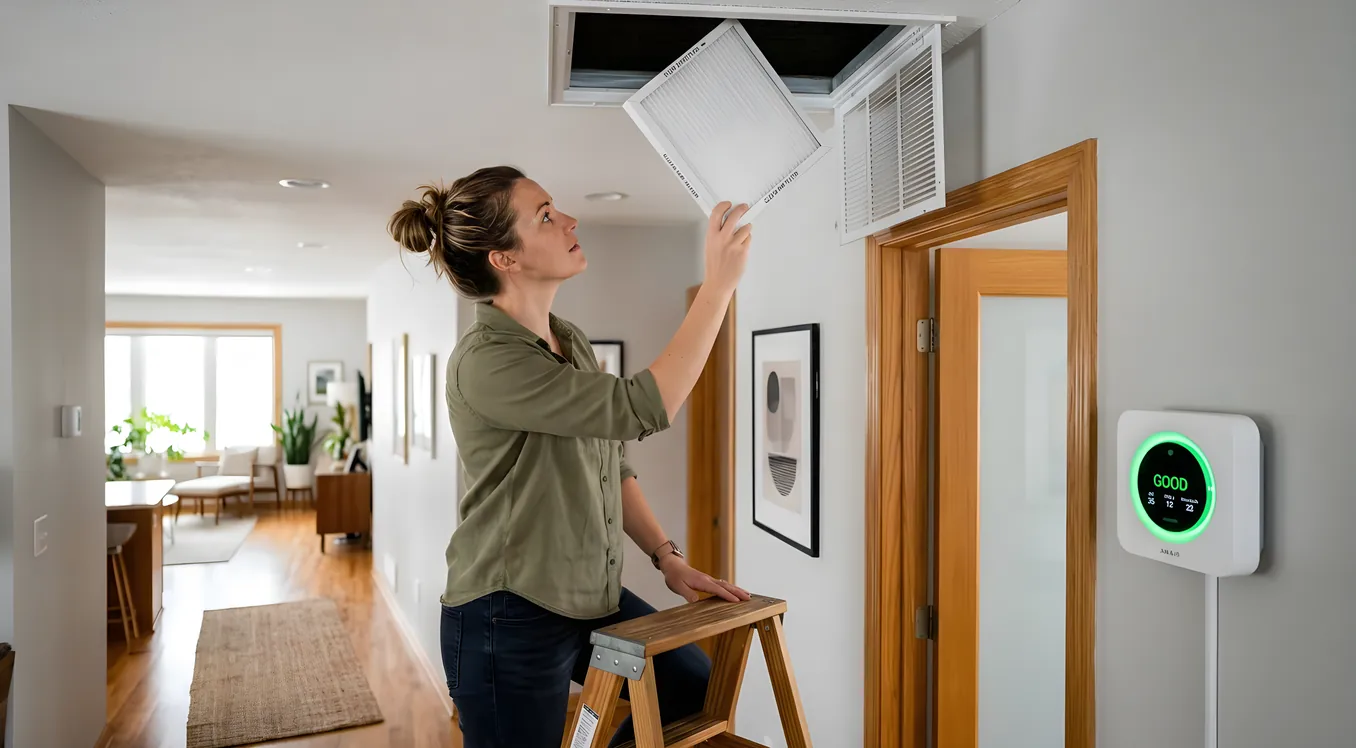
Most homeowners think about air quality once a year, when they remember to swap the furnace filter. That instinct is reasonable for a conventional HVAC system running a basic fiberglass filter, but it misses everything the air in your home is actually doing between those annual checkups. Fine particulates, volatile organic compounds, carbon dioxide buildup, humidity imbalances, and radon each affect your health and comfort in ways that a MERV 8 filter swap never addresses. A well-built indoor air quality monitoring setup turns this from a once-a-year guess into a continuous picture you can actually act on.
This article covers how smart air quality monitors work, what sensors matter, how connected filters and HVAC integration layer in, what the leading hardware options actually cost, and how to build a setup that connects intelligently to the broader climate control system in your home.
Why Indoor Air Quality Is Harder Than Outdoor Air Quality
The EPA has spent decades building outdoor air quality monitoring networks. You can pull up the AQI for your zip code in seconds. Indoor air quality is a different problem entirely, because the sources, concentrations, and dynamics inside a home are specific to what’s happening inside that envelope.
Cooking generates particulate matter that can spike PM2.5 readings to 200+ micrograms per cubic meter in under five minutes. A new couch, freshly painted walls, or new flooring off-gasses volatile organic compounds for weeks to months after installation. A gas range running without ventilation pushes nitrogen dioxide into breathing air. A sealed modern home with good insulation trades energy efficiency for CO2 buildup from occupancy, which affects cognitive performance at levels most homeowners never think to measure.
None of this shows up in an outdoor AQI check. And none of it gets addressed by changing your furnace filter, regardless of what MERV rating is on the box.
The reason this matters now, specifically, is that sensor technology has gotten cheap and accurate enough to put continuous, real-time IAQ monitoring in reach of any homeowner, not just building engineers with specialized equipment. A credible PM2.5/CO2/VOC/humidity sensor array cost $800 to $1,200 in 2019. Equivalent capability in a consumer package now runs $150 to $400. That shift changes the calculus on whether to monitor versus guess.
The Sensors That Actually Matter
A smart air quality monitor is only as useful as the sensors inside it. Marketing tends to bundle as many parameters as possible into the spec sheet; not all of them carry equal weight in a residential context.
PM2.5 (fine particulate matter) is the most clinically significant measurement for most households. Particles smaller than 2.5 microns penetrate deep into lung tissue and are associated with cardiovascular and respiratory disease at long-term exposure. The WHO updated its air quality guideline for PM2.5 to 5 micrograms per cubic meter annual mean in 2021, down from 10. Most US homes run 5 to 20 micrograms per cubic meter under normal conditions; cooking spikes, wildfire smoke events, and poor filtration can push this dramatically higher. Look for monitors using laser particle counters, not cheaper optical sensors. The difference matters at the low end of the measurement range.
CO2 measures carbon dioxide concentration, typically in parts per million. Outdoor air runs around 420 ppm. A well-ventilated home should stay under 1,000 ppm. Readings above 1,000 ppm correlate with measurable cognitive decline in studies; above 2,000 ppm in a bedroom overnight is not uncommon in tightly sealed homes with no ventilation and two sleeping occupants. CO2 concentration is also the most practical proxy for ventilation adequacy. If CO2 is high, you’re not moving enough fresh air through the space.
TVOCs (total volatile organic compounds) covers a broad family of off-gassing chemicals from building materials, cleaning products, paints, adhesives, and furnishings. True compound-specific VOC analysis requires lab-grade equipment. Consumer sensors measure total VOC load as a relative indicator. This is useful for tracking changes over time and catching acute events (fresh painting, new furniture) rather than identifying specific compounds.
Relative humidity directly affects mold growth risk, dust mite populations, and comfort. The target range for most homes is 35 to 55 percent. Below 30 percent in winter causes respiratory irritation and static electricity. Above 60 percent in summer creates conditions for mold and off-gassing acceleration from building materials. Humidity monitoring is also diagnostic for HVAC system performance, since a system that’s undersized or improperly set won’t maintain humidity targets regardless of temperature set point.
Carbon monoxide warrants a standalone detector even if you have a combined IAQ monitor. Most smart air quality monitors measure CO2 (carbon dioxide), not CO (carbon monoxide). These are different gases. Carbon monoxide is a combustion byproduct that is acutely lethal at high concentrations. If you have gas appliances, an attached garage, or a fireplace, CO monitoring should be a separate, certified UL-listed detector, not an afterthought on an IAQ device.
Radon is a secondary consideration that’s worth raising separately. It’s a radioactive decay product that seeps in from soil and is the second-leading cause of lung cancer in the US. A few smart monitors include radon sensing. The Airthings Wave Plus ($229) is the most widely used consumer radon monitor with connected reporting. For whole-home screening, a 90-day passive test kit from a certified lab is more accurate than consumer sensor averages, but for ongoing trend monitoring in a basement or first floor, the Airthings approach gives useful directional data.
Leading Smart Air Quality Monitor Hardware
Airthings View Plus ($299): The View Plus is a ceiling or wall-mounted hub unit with a color display. It measures PM2.5, radon, CO2, TVOCs, humidity, temperature, and atmospheric pressure. The companion app (iOS/Android) shows historical trends across all parameters. The View Plus connects to the Airthings Hub, which enables API access for integration with Home Assistant, SmartThings, and other platforms. Battery-powered operation with optional USB-C power. A strong first choice for homeowners who want a single device covering the full IAQ parameter set.
Awair Element ($299): Measures PM2.5, CO2, TVOCs, temperature, and humidity. No radon. The Awair app is well-regarded for its coaching interface, which translates readings into actionable recommendations rather than just raw numbers. It supports IFTTT, Home Assistant via community integration, and a developer API (requires a paid API plan for commercial use). The Element connects over WiFi and pulls relatively low power. One limitation: no local processing, all data routes through Awair’s cloud, which matters for privacy-conscious users or those in smart home setups that prefer local control.
IQAir AirVisual Pro ($299): Specifically strong on PM2.5 measurement using a dual-laser sensor that performs well at low concentrations. Also measures CO2, temperature, and humidity. The AirVisual platform correlates indoor readings with outdoor AQI from the nearest monitoring station, which helps contextualize whether your filtration is keeping pace with outdoor events like wildfire smoke. The Pro unit includes a 2.8-inch color display with a traffic-light style IAQ indicator. It connects over WiFi and syncs to the AirVisual app. Less integration depth than Airthings or Awair for smart home platforms, but the PM2.5 sensor is among the most accurate in the consumer category.
Ecobee SmartSensor (with premium subscription) ($79 per sensor): If you’re already running an ecobee smart thermostat, the SmartSensors add occupancy and temperature data across rooms, and the ecobee premium tier now includes air quality index reporting at the thermostat level. This is not a full IAQ suite, but it’s a low-friction way to add air quality context to a system you’re already running. For more on how ecobee stacks up against competing thermostat platforms, Smart Thermostats: Nest vs Ecobee vs Professional HVAC Control covers the tradeoffs in detail.
Foobot (discontinued as of 2023): Mentioned because it shows up in older buying guides. Foobot’s cloud service shut down and the device is effectively a paperweight. This is a practical reminder that cloud-dependent monitors are as vulnerable as the company running the backend.
Smart Filters and Connected HVAC Filtration
Filters are the mechanical component that actually removes particles from air. Monitoring tells you what’s in the air; filtration changes what’s in the air. These are separate systems that benefit from working together.
MERV ratings (Minimum Efficiency Reporting Value) run from 1 to 16 for residential applications. A standard 1-inch fiberglass filter is MERV 2 to 4 and catches large debris but does almost nothing for PM2.5. MERV 11 to 13 filters capture fine particles in the 0.3 to 1 micron range with 85 to 90+ percent efficiency and are appropriate for most residential forced-air systems. MERV 14 to 16 approaches HEPA territory but creates enough airflow restriction that many residential HVAC systems can’t handle it without static pressure problems. Match the filter to your system’s rated airflow capacity, not just the slot dimensions.
The “smart” piece of filter management has evolved in two directions:
Filter condition monitoring attaches a pressure differential sensor across the filter slot to measure airflow resistance. As a filter loads up with captured particles, differential pressure rises. Products like the 3M Filtrete Smart Filter ($29.99 for a 4-pack of filters plus the Bluetooth sensing module) use this approach. The Filtrete app reports estimated filter life remaining based on actual airflow restriction rather than a generic “change every 90 days” calendar reminder. A filter in a home with three pets and two children loads faster than one in a two-person household with hardwood floors. Actual condition monitoring captures that difference.
Filter-integrated sensors take this further by embedding air quality sensing directly into the return air plenum where the filter sits. Aprilaire’s Model 8600 and 8620 WiFi thermostats pair with IAQ sensors that mount in the return air duct, measuring temperature, humidity, and particles at the filter itself. This location captures air from the entire house before it reaches the system, giving a representative whole-home sample rather than a spot measurement in one room.
iWave-R ($350 to $400 installed) is a needlepoint bipolar ionization device that mounts inside return air ductwork and continuously generates positive and negative ions that attach to airborne particles and pathogens. This is a different filtration approach than mechanical media filters. Ionization causes particles to clump together and fall out of the air or get captured more easily by downstream filters. It does not replace a MERV 13 filter but works alongside it. iWave-R is one of the more common upgrades HVAC contractors install during smart home integration projects.
Whole-home air purification systems like the Lennox PureAir S or Carrier Infinity Air Purifier integrate directly into the air handler and run continuously. The Lennox PureAir S uses a combination of MERV 16 filtration and UV light with a photocatalytic titanium dioxide process. Installation cost runs $800 to $1,500 for the hardware, with an additional $200 to $400 in contractor labor. Unlike portable room purifiers, whole-home systems treat all circulated air in every room every time the system runs.
Integration with Smart Home Platforms
A standalone air quality monitor that sits on a shelf reporting data to a phone is a start. The real leverage comes from connecting IAQ data to the broader smart home system so that readings can trigger ventilation, filter the air more aggressively, or alert you to take action.
Home Assistant is the most capable platform for local IAQ integration. Airthings devices (via the Airthings integration), Awair Element (via community integration), and many Z-Wave or Zigbee IAQ sensors connect natively. You can build automations that open ERV (energy recovery ventilator) dampers when CO2 rises above 1,200 ppm, trigger HVAC fan-only operation when PM2.5 spikes above a threshold, or push priority alerts when humidity drops below 30 percent in winter.
ecobee connects directly to a limited set of IAQ sensors and can adjust ventilation schedules based on air quality parameters in its premium tier. If your system includes a controlled fresh air intake or ERV, ecobee can orchestrate ventilation changes automatically.
Control4 and Crestron installations at the high end typically integrate IAQ sensors through the driver ecosystem. Control4 drivers exist for Airthings, Awair, and custom IAQ sensor arrays. In a full Control4 system, IAQ data can appear on touchpanels throughout the house, trigger HVAC scenes, and feed into energy management logic. This level of integration makes the most sense in new construction or whole-home automation projects where HVAC, lighting, and climate control are being designed together. For an overview of how room-by-room climate control layers into this, Zoned HVAC and Smart Dampers: Room-by-Room Climate Control covers the damper and zone control architecture that IAQ monitoring pairs with naturally.
SmartThings and Apple Home have more limited native IAQ sensor support but can pull from virtual switches and scenes triggered by platforms like Home Assistant via webhook or cloud integration. The workaround is workable but adds complexity.
One integration worth calling out separately: whole-home energy monitoring platforms like Emporia Vue or Sense can correlate HVAC runtime with IAQ readings over time, revealing patterns like filtration cycles that correlate with energy consumption spikes. Whole-Home Energy Monitoring: Track and Reduce Consumption covers how to set up this kind of cross-system view.
Building a Practical IAQ Monitoring Setup
The right setup depends on home size, existing HVAC equipment, and how deeply integrated you want the data to be. Here’s a practical framework:
Single-sensor starter setup ($200 to $300): One Airthings View Plus or Awair Element placed in the primary living area (ideally away from windows, cooking areas, and direct HVAC vents). This gives you representative whole-home data for PM2.5, CO2, TVOC, and humidity. Add a radon test kit for basement spaces. Connect to Home Assistant or the device’s native app for historical trending.
Multi-zone monitoring ($500 to $900): Add sensors in bedrooms and the basement. CO2 levels in occupied bedrooms overnight are consistently higher than living areas; catching this drives better ventilation decisions. Basement radon monitoring with an Airthings Wave Plus covers the highest-risk zone for radon infiltration. Three Airthings units networked through the Airthings Hub gives unified reporting across the house.
Integrated filtration and monitoring ($1,500 to $4,000 installed): Upgrade to a MERV 13 filter in a 4-inch or 5-inch media cabinet if your air handler can support the depth (most can, with an adapter cabinet). Add an iWave-R ionization unit in the return air plenum. Install duct-mounted IAQ sensors near the return air plenum. Connect the entire setup to Home Assistant or ecobee for automated ventilation control triggered by real IAQ data. This configuration treats air quality as a system-level concern rather than an accessory.
Whole-home premium ($4,000 to $8,000+ installed): Add a whole-home air purification system (Lennox PureAir S, Carrier Infinity Air Purifier, or equivalent), a whole-house humidifier with humidity sensor feedback, a balanced ventilation system (ERV or HRV) controlled by CO2 levels, and professional HVAC integration with Control4 or similar platform. At this level, the home’s air quality is actively managed around occupancy and outdoor conditions rather than on a fixed schedule.
What the Data Is Actually Telling You
Collecting IAQ data is the easy part. Knowing what to do with it requires understanding the baselines and thresholds that matter.
PM2.5 above 35 micrograms per cubic meter (the EPA 24-hour standard) warrants action: closing windows during wildfire events, running HVAC filtration continuously, or running a portable HEPA purifier in occupied rooms. Persistent readings above 12 micrograms per cubic meter (the EPA annual standard) in a home with a good MERV 13 filter suggest an infiltration source worth investigating: a leaking return air duct pulling from an unconditioned attic, an attached garage door seal issue, or fireplace damper air leakage.
CO2 above 1,000 ppm consistently indicates insufficient ventilation. Opening a window is the fastest fix. Running an ERV or HRV is the engineered solution. Rising CO2 during sleeping hours specifically suggests you need fresh air supply to bedrooms, which most HVAC systems don’t provide unless specifically designed for it.
TVOC spikes that correlate with specific events (new furniture delivery, painting, cleaning product use) are expected and temporary. Persistent elevated TVOC readings in a home with no obvious source often trace to a specific building material. Flooring adhesives, some spray foam installations, and certain cabinetry off-gas for extended periods. Identifying the source is more useful than just running more purification against it.
Humidity swings in a well-insulated home that has a working HVAC system often point to duct leakage, failed vapor barriers in crawlspaces, or HVAC equipment that’s oversized for the load (short-cycling means less dehumidification). IAQ data doesn’t fix these, but it surfaces the problem in a way that’s hard to ignore.
Getting the Most Out of a Smart Air Quality Monitor
The homeowners who get real value out of IAQ monitoring are the ones who treat sensor readings as diagnostic input rather than noise. Check baselines in each season. Note what cooking, occupancy patterns, and outdoor events do to your numbers. When you see a persistent anomaly, trace it to a source rather than dismissing it as sensor error.
The smartest setup isn’t necessarily the most sensors. It’s sensors placed where they measure what you actually care about, connected to a platform that lets the data drive actual HVAC behavior, and paired with filtration that’s matched to your real pollutant profile rather than the cheapest filter that fits the slot.
Air quality is the one aspect of home comfort that affects every occupant, every hour they’re home, without them ever noticing it’s happening. That’s precisely why it’s worth getting right.