Zoned HVAC and Smart Dampers: Room-by-Room Climate Control
Most homes are built with a single thermostat controlling one HVAC system that pumps conditioned air everywhere simultaneously. The master bedroom gets the same treatment as the guest room nobody’s using. The kitchen heats up from cooking and gets blasted with the same cold air as the living room. The south-facing sunroom bakes in the afternoon while the north-facing home office stays chilly. A single-zone system has no way to know any of this and no way to respond.
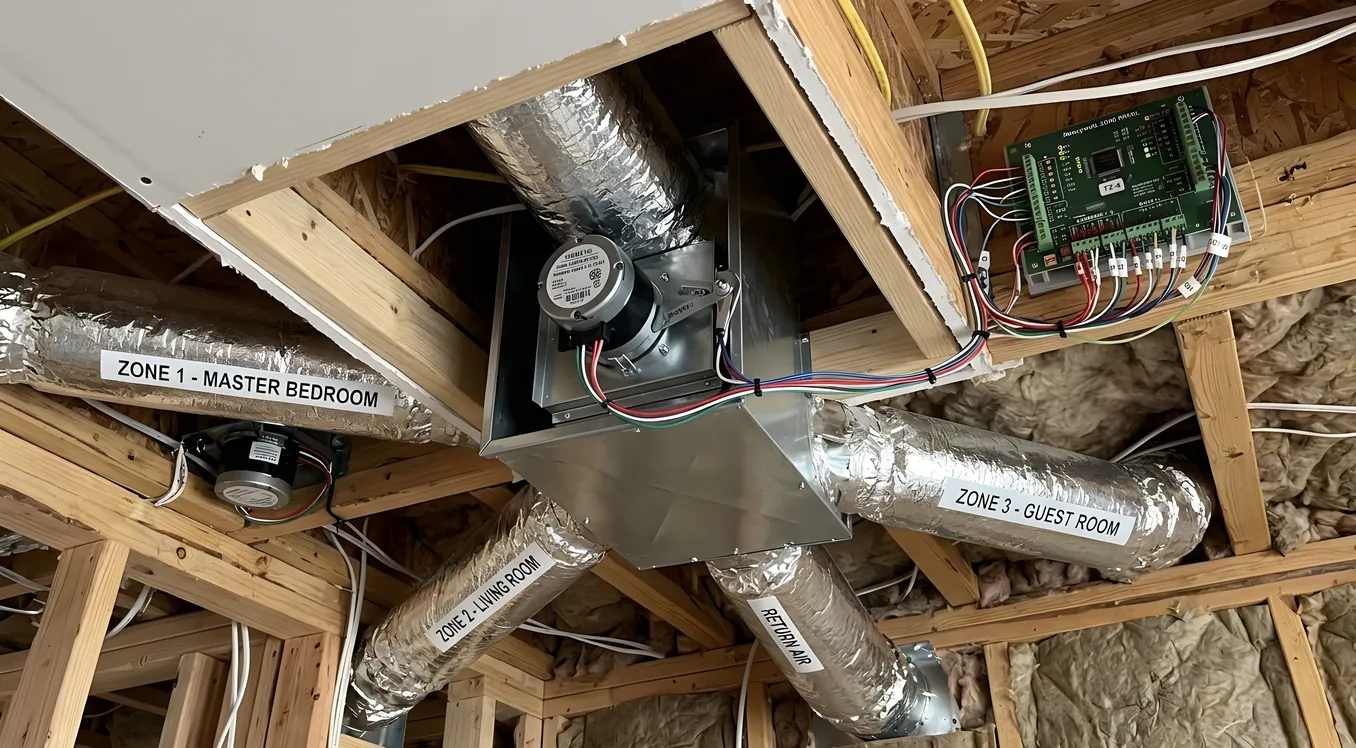
Zoned HVAC fixes this by dividing the home into independent climate zones, each with its own thermostat and its own motorized damper in the ductwork. When the bedroom zone calls for cooling, a damper opens in the bedroom trunk line. Dampers in other zones stay closed or modulate based on their own needs. The result is that you’re conditioning the spaces that need conditioning rather than the whole house at once.
For homeowners researching smart home systems, HVAC zoning is often underestimated. It connects directly to comfort, energy costs, and how well the rest of the automation stack works. Getting it right early in a build or renovation changes how you heat and cool a home for decades.
How Ductwork Zoning Actually Works
A standard single-zone forced-air system has one air handler (or furnace), one thermostat, and ductwork that branches out to every room. The thermostat sends a signal, the system runs until the setpoint is reached, and air goes everywhere whether it’s needed or not.
A zoned system inserts motorized dampers into the branch ducts. These are typically round or rectangular metal plates that rotate inside the duct, from fully open (zero restriction) to fully closed (complete block). They’re controlled by a zone controller, which is a small panel wired to each thermostat and each damper actuator. When Zone 2 (upstairs bedrooms) calls for cooling, the zone controller opens the Zone 2 dampers and closes or partially closes the Zone 1 and Zone 3 dampers. The air handler runs and the conditioned air goes primarily where it’s needed.
The zone controller also manages a bypass damper, which is critical. When multiple zones close simultaneously, you have a running air handler pushing air into a restricted duct system. Static pressure builds. Without relief, this overpressures the ducts, stresses the air handler, can collapse flex duct, and makes the system noisy. The bypass damper opens automatically to vent excess air back to the return plenum, keeping system pressure within safe limits.
Better zone controllers modulate damper positions rather than snapping fully open or closed. This gives the air handler a more consistent load and allows finer temperature control. The Honeywell TrueZONE (HZ432) handles up to four zones and retails around $200 to $250. Carrier’s Infinity System controller can manage up to eight zones and pairs with Carrier’s variable-speed equipment for true modulation. EWC Controls and Arzel are specialty zone controller manufacturers with systems designed for retrofit applications.
Smart Thermostats and Zone Control: Where They Meet
This is where a lot of homeowners get confused: a smart thermostat like a Nest or ecobee is not inherently a zoning device. It’s a single intelligent thermostat. If you have a single-zone system, replacing your old thermostat with an ecobee SmartThermostat Premium ($249) gets you scheduling, remote access, occupancy sensing, and learning. It does not create multiple zones.
Zoning requires zone controllers and physical dampers in the ductwork. Smart thermostats can be wired into a multi-zone system as the individual zone thermostats, but the zone controller still does the coordination. An ecobee as Zone 1 thermostat, another ecobee as Zone 2 thermostat, all wired into an HZ432 zone controller: that’s a functional smart zoned system. Each zone’s thermostat talks to the zone controller, which orchestrates dampers and equipment staging.
Where it gets interesting is with smart thermostats like Nest, ecobee, and professional HVAC controls that offer room sensors. The ecobee comes with one SmartSensor and supports up to 32 sensors placed throughout the home. These sensors report temperature and occupancy back to the main thermostat. Using their “Follow Me” feature, the thermostat weights the temperature toward whichever rooms are occupied. This is a form of pseudo-zoning. It doesn’t open and close dampers, but it does make smarter decisions about when to call for heating or cooling based on where people actually are.
For a light-touch approach in an existing home with single-zone ductwork, ecobee’s sensor approach can meaningfully improve comfort without opening up walls. It’s not the same as true zoning, and you should go in with honest expectations. But it’s also not nothing.
When Zoning Makes Financial Sense
The cost of a retrofit zoning system depends heavily on the number of zones and the complexity of the ductwork. A two-zone system in a straightforward ranch house might run $1,500 to $3,000 installed. A four-zone system in a two-story colonial with multiple air handlers might run $4,000 to $8,000 or more. New construction is always cheaper because dampers get installed during the rough-in before drywall goes up.
The payback calculation depends on your situation. The Department of Energy estimates that proper HVAC zoning can reduce heating and cooling costs by 20 to 30 percent in homes with significant variations in occupancy, orientation, or room use. A 2,500-square-foot home spending $2,400 per year on HVAC could save $500 to $700 annually. At those numbers, a $4,000 retrofit pays back in six to eight years, before accounting for equipment longevity benefits from reduced runtime.
Where zoning pays back faster:
Multi-story homes. Heat rises. The second floor is almost always warmer than the first, especially in summer. A system sized to cool the second floor will overcool the first. A two-zone system with separate control of each floor is one of the highest-value zoning applications.
Rooms with high solar gain. A south or west-facing sunroom, a conservatory, or a home with a lot of south-facing glass creates a room that gains massive heat on sunny afternoons. Conditioning that room together with the rest of the house means the whole system runs harder to compensate for one problem space. A dedicated zone for that room (or zones, for complex layouts) lets you treat it appropriately without overcooling everything else.
Mixed-use homes. A home office that’s occupied 9 to 5 but dark on weekends has different conditioning needs than a living room that’s used mostly evenings. Zoning lets you program these zones independently.
Homes with in-law suites, additions, or finished basements. These spaces are often climatically disconnected from the main house. An addition built 20 years after the original construction likely has mismatched ductwork and insulation. A finished basement stays cold in winter and needs different treatment than the living areas above. These are natural zone candidates.
The case for zoning weakens in small, single-story, open-plan homes with consistent occupancy patterns. A 1,200-square-foot condo where two people work from home in the same room most of the day has less to gain from zone separation.
Smart Damper Systems: Retrofit Without Ductwork Surgery
Traditional zoning requires a contractor to cut into existing ductwork and install motorized dampers at strategic points, then run low-voltage control wiring back to a zone controller. For retrofits in finished homes, this is invasive and expensive.
Smart damper systems like Flair and EcoVent take a different approach: motorized vent covers installed over existing floor or wall registers, no ductwork modification required. Flair Pucks (about $100 each) are smart vents that open and close over existing registers, coordinating with a mini-hub and wireless thermostats in each room to control airflow room by room. You can add or remove zones without opening walls.
The tradeoff is that smart vents work against the static pressure problem without a bypass damper. Closing multiple vents simultaneously does increase duct pressure. On modern, properly-sized systems, this is usually manageable. On older systems with marginal sizing or existing ductwork issues, it can cause problems: noise, reduced airflow at open vents, or accelerated equipment wear.
Flair’s system addresses this by learning how your system behaves and avoiding extreme pressure conditions. It also communicates with a compatible thermostat to coordinate equipment staging. The Flair system works with ecobee, Nest, Honeywell, and Sensibo, among others. A starter kit for two rooms runs about $250 to $350, and scaling to a whole home might cost $600 to $1,200 in hardware before professional help.
For homeowners who want the flexibility of room-level control without a full retrofit, Flair represents a meaningful option. For homeowners doing a renovation or building new, traditional hardwired zoning with quality zone controllers is the more robust long-term solution.
Variable-Speed Equipment: The Missing Half of Effective Zoning
Most zoning discussions focus on dampers and zone controllers, which is where the visible complexity lives. What often goes undiscussed is that zoning works significantly better with variable-speed HVAC equipment.
Single-stage equipment is binary: fully on or fully off. When only one small zone calls for cooling, a single-stage system blasts full capacity into that zone, satisfies the thermostat quickly, shuts down, and short-cycles. Short-cycling is hard on compressors, reduces efficiency, and produces humidity control problems because the system doesn’t run long enough to remove moisture from the air.
Variable-speed equipment, sometimes called modulating or inverter-driven, can ramp capacity up and down continuously, typically from 25 to 100 percent capacity. When a small zone calls for cooling, a variable-speed system runs at low capacity for a long time, moving less air at a consistent rate. This produces better dehumidification, quieter operation, less temperature swing, and longer equipment life.
The Carrier Infinity System pairs Carrier’s variable-speed air handlers and heat pumps with the Infinity Touch Control (SYSTXCCITC01) and a zone controller that can manage up to eight zones. The system communicates digitally, so the air handler knows exactly what each zone needs and modulates accordingly. Similar systems are available from Lennox (iComfort), Trane (ComfortLink II), and Bryant. Budget around $8,000 to $15,000 installed for a premium variable-speed zoned system depending on home size and zone count, but equipment longevity and efficiency gains change the 10-year cost picture substantially.
For the highest level of precision, Mitsubishi Electric’s Mr. Slim and H2i ductless mini-split systems eliminate ductwork entirely. Each indoor unit handles its own zone independently, with its own thermostat and variable-speed compressor. Mini-splits consistently run SEER ratings of 20 to 30+, compared to typical central forced-air systems at 14 to 18 SEER. For additions, garages, sunrooms, or rooms that are notoriously difficult to condition with central air, a mini-split is often the most practical solution. A single-zone mini-split from Mitsubishi, Daikin, or LG runs $2,500 to $5,000 installed; multi-zone systems with one outdoor unit and four indoor units might run $7,000 to $14,000.
Integration with the Broader Smart Home System
Standalone HVAC zoning provides real value even without deeper integration. But connected to a whole-home automation platform, it becomes part of how the house responds to how people live in it.
Control4, Savant, and Crestron all offer HVAC integration as part of their dealer-installed automation systems. In a Control4 home, arrival at the driveway can trigger the occupied zone schedule. Leaving for work sets all zones back automatically. A “Movie Night” scene dims the lights in the family room and raises the family room zone setpoint slightly because body heat from four people watching a film will warm that room on its own. The system can respond to conditions, not just schedules.
The ecobee API is open and documented, which makes it a common integration point for Home Assistant users building custom automation. A Home Assistant instance can read the temperature from every ecobee sensor, track occupancy from those sensors and from other presence devices like phones or security cameras, and make zone control decisions based on a fuller picture than the zone controller alone can see.
Tracking HVAC runtime and energy consumption at the zone level also feeds into whole-home energy monitoring systems, which lets you see whether a problem zone is driving outsized electricity costs and whether schedule changes are producing measurable savings. Pairing zone data with solar production data from a solar and smart home integration system can enable pre-cooling or pre-heating during peak solar hours when electricity is cheapest or even free, automatically, without any manual intervention.
What to Watch Out for During Installation
A zoned system installed carelessly can perform worse than the single-zone system it replaced. The most common failure modes:
Undersized bypass damper. When multiple zones close, the bypass must handle the full airflow that would otherwise go to those zones. An undersized bypass creates back-pressure that the equipment can’t run against efficiently.
Too many zones for the air handler. An air handler designed to condition a 2,400-square-foot home can’t condition a 400-square-foot bedroom zone adequately at full capacity. The mismatch between equipment size and zone size is the root of most short-cycling problems in zoned systems.
Poor sensor placement. A zone thermostat placed near a west-facing window or adjacent to a bathroom exhaust fan gives bad readings. The zone controller acts on what the sensors report.
Dampers installed backwards or at wrong locations. Branch duct damper position matters. Dampers should be close to the main trunk, not at the register. Dampers installed too close to the air handler can create pressure problems even when open.
Ask any contractor quoting a zoning retrofit about their approach to bypass damper sizing and how they handle pressure balancing. The quality of the conversation tells you a lot about the quality of the installation.
Air Quality Across Zones
One underappreciated aspect of HVAC zoning is its interaction with air filtration and indoor air quality. When a zone closes and the air handler runs at reduced capacity through remaining open zones, the system is filtering a subset of the home’s air. Rooms with closed dampers are not getting air circulation, which affects everything from CO2 concentration to allergen levels.
Smart HVAC filters and air quality monitoring can help identify which zones need more attention and whether the current filtration setup is adequate for reduced-flow conditions. Aprilaire and iWave offer whole-home air purification that works with the existing ductwork and doesn’t depend on airflow to every zone simultaneously. A dedicated air quality sensor in each zone gives you real data on whether the zoning schedule is creating stagnant air in any part of the house.
For bedrooms specifically, supplemental air purification with units like the Coway Airmega 400 or Blueair Classic 605 makes sense in zoned systems because these rooms may spend hours with their dampers partially closed while the occupants sleep.
Building the Right System for Your Home
The right zoning configuration depends on the home’s floor plan, HVAC equipment age, ductwork condition, occupancy patterns, and budget. There’s no single right answer.
For a new construction or gut renovation, the case for full hardwired zoning with variable-speed equipment is strong. The incremental cost over single-zone installation is modest when ductwork is exposed, and the lifetime benefits are significant. Four to six zones in a 3,000-square-foot home is a reasonable starting point: first floor, second floor, primary suite, bonus room or sunroom, basement if finished.
For a finished home with good existing ductwork, a two-zone retrofit targeting the most obvious divide (upstairs/downstairs, or main living areas vs. sleeping areas) often delivers 80 percent of the benefit at a fraction of the cost of a full zone retrofit.
For homeowners who want to try room-level control without structural work, Flair’s smart vent system with a compatible smart thermostat is a reasonable starting point. Go in knowing the limitations and monitor duct pressure behavior after installation.
What makes zoned HVAC genuinely valuable in a smart home is that it aligns the HVAC system with how people actually use the home. Conditioning empty rooms is waste. Overcooling common areas to compensate for problem rooms is waste. A zoned system, paired with smart scheduling and occupancy sensing, stops doing both. For a home where HVAC represents 40 to 50 percent of total energy consumption, that alignment has real, compounding financial value over time.