Smart Whole-House Dehumidification and Humidity Control
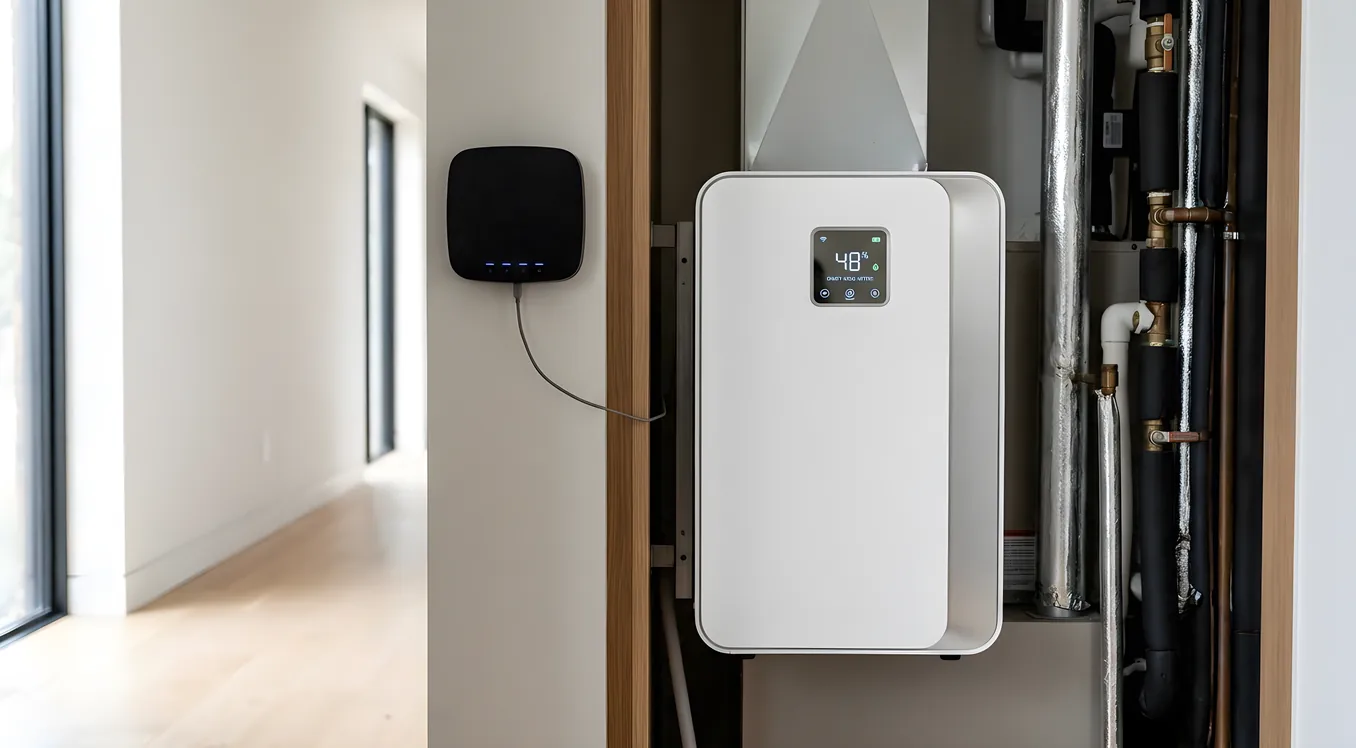
Excess humidity is one of those home problems that creeps up slowly. You notice a musty smell in the basement. The windows fog in the morning. Wood floors start to cup. Bathroom tiles develop a persistent grey haze. By the time you’re dealing with visible mold or warped cabinetry, the moisture problem has been building for months.
A portable dehumidifier in the basement handles the worst of it temporarily. But it requires constant emptying, it only addresses one room, and it does nothing for the rest of the house. Whole-house dehumidification solves the problem at the source, and when you add smart controls, it becomes something you set up once and monitor remotely rather than babysit.
This guide covers how whole-house dehumidifiers work, which systems integrate cleanly with smart home automation, what realistic installation looks like, and how to size and spec a system for your home.
Why Portable Units Fall Short
A portable dehumidifier rated at 50 pints per day sounds substantial. And for a single large room, it is. But typical two-story homes above 2,000 square feet have moisture infiltration through the building envelope, from crawl spaces, through basement walls, and from daily activities (cooking, showers, breathing, houseplants) distributed throughout the structure. Addressing only one room means the rest of the house stays at elevated humidity levels, which continue to drive dust mite populations, trigger allergy symptoms, and slowly damage wood and drywall.
Whole-house dehumidifiers integrate with your HVAC ductwork and process air from the entire structure. They typically remove between 70 and 155 pints of water per day, depending on the unit. They drain to a floor drain or condensate pump rather than a collection bucket, which means you don’t empty them. And they run on a humidistat rather than manually, so they cycle on and off as needed without attention.
For homes with persistent humidity problems, basements, crawl spaces, or located in humid climates (the Southeast, Gulf Coast, Pacific Northwest, anywhere with 60-plus percent average summer relative humidity), a whole-house system is the correct tool.
How Whole-House Systems Work
Most whole-house dehumidifiers are ducted units that pull return air from the home, pass it across a refrigerant coil that cools the air below its dew point (causing moisture to condense out), then re-heat and return the dried air either to the HVAC return plenum or to a specific zone.
Installation configurations vary. The most common approach draws air from the HVAC return duct and delivers dried air back to the supply side. This lets the dehumidifier work in concert with the air handler without requiring separate ductwork runs. For homes with basements or crawl spaces, you can also install a dedicated unit that handles that zone independently, with its own ductwork loop.
Dedicated whole-house units are separate from your air conditioner. Air conditioners do remove some humidity as a byproduct of cooling, but they’re sized for temperature control, not moisture removal. When outdoor temperatures are moderate (60-70 degrees) but humidity is high, the AC won’t run long enough to adequately dehumidify. A dedicated dehumidifier addresses humidity independently of cooling, which matters significantly in spring and fall shoulder seasons.
Sizing the System
Sizing comes down to four variables: square footage, climate zone, construction type, and basement or crawl space presence.
The industry standard sizing method uses pints-per-day (ppd) removal capacity at AHAM conditions (80 degrees F, 60 percent relative humidity). Here are rough guidelines:
- 1,000 to 1,500 sq ft without basement: 70-90 ppd unit
- 1,500 to 2,500 sq ft without basement: 90-110 ppd unit
- 2,500 to 4,000 sq ft with basement: 110-130 ppd unit
- 4,000 sq ft and above, or homes with crawl spaces in humid climates: 130-155 ppd unit (or multiple units)
High-infiltration homes (older construction, poor sealing, large basement or crawl space) should size up. Tight new construction can sometimes size down.
For crawl space installations, the calculation changes. A crawl space is essentially a moisture pump that drives ground-sourced water vapor into the living space above it. You want a dedicated unit specifically designed for low-temperature operation (crawl spaces run cooler than living areas, and most residential dehumidifiers lose efficiency or stop operating below 55 degrees F). Units designed for crawl spaces, like the Aprilaire E080 or the Santa Fe Compact70, maintain performance down to 49 degrees F and below.
Leading Whole-House Dehumidifier Systems
Aprilaire
Aprilaire is the most widely installed whole-house dehumidifier brand in North America, and their units are what most HVAC contractors reach for by default. The current lineup covers three main products:
Aprilaire E080: 80-pint-per-day unit for homes up to about 2,200 sq ft. Designed for basements and crawl spaces. Operates down to 49 degrees F. Drain hose outlet included. MSRP around $900-1,100; installed cost typically $1,500-2,000.
Aprilaire E100: 100 ppd unit for larger basements or whole-home ducted applications up to 3,000 sq ft. This is the most common whole-home installation unit. MSRP approximately $1,200-1,400; installed $2,000-2,800.
Aprilaire E130: 130 ppd for large homes or high-humidity climates. Installed cost typically $2,800-3,500.
Aprilaire’s strength is ecosystem integration. Their controls communicate over a proprietary bus and can interface with Aprilaire thermostats, ventilators, and air cleaners. For homeowners with an Aprilaire 8620W thermostat or the IAQ 5000 controller, humidity control integrates directly into the same interface. Third-party smart home integration happens through their Universal Digital Control (model 8910W), which exposes humidity setpoints and status over a relay output that HVAC integrators can wire to automation systems.
Santa Fe
Santa Fe (manufactured by Therma-Stor) makes some of the most efficient whole-house and crawl space dehumidifiers on the market. Their units are popular with building science practitioners and encapsulation contractors.
Santa Fe Compact70: 70 ppd, designed specifically for crawl spaces and small basements. Operates down to 49 degrees F. Approximately 5.2 amps at 120V. MSRP around $1,100; installed $1,800-2,200.
Santa Fe Ultra155: 155 ppd, the most powerful residential unit in the Santa Fe lineup. Designed for large whole-home ducted applications or particularly challenging humidity environments. Requires 240V supply. MSRP approximately $2,800; installed $4,000-5,500.
Santa Fe Impact155: Similar capacity to the Ultra but in a horizontal configuration that suits attic installations.
Santa Fe units do not have native Wi-Fi or smart home integration built in. They operate on a standard humidistat input, which means you control them by either a traditional analog humidistat or a smart humidistat that provides a 24V signal. This makes them compatible with any home automation system that can output a relay or 24V dry contact signal, but it requires an additional controller. More on that integration approach below.
Honeywell (Resideo)
Resideo (the Honeywell Home brand spun off from Honeywell in 2018) offers the TrueDRY DR90 and DR65, whole-house units in 90 and 65 ppd configurations. These are popular for in-duct applications and pair with Honeywell Home’s thermostat line. The DR90 retails around $1,400 and installed runs $2,200-3,000. Native integration with the Honeywell Home T10 Pro thermostat allows humidity control from the same display and app used for temperature, which simplifies the homeowner experience considerably if you’re already in the Honeywell ecosystem.
For homeowners with an ecobee or Nest thermostat managing temperature, the Honeywell DR90 can still operate in parallel via its own humidistat, though you’ll manage the two independently unless you add an integration layer.
Smart Controls and Home Automation Integration
This is where whole-house dehumidification gets significantly more capable, and where the setup decisions start to matter.
Standalone Smart Humidistats
The simplest upgrade is replacing a standard mechanical humidistat with a smart one. Ecobee does not make a standalone smart humidistat. Nest’s ecosystem doesn’t have one either. But several strong options exist:
Aprilaire 8620W: This is a full thermostat and IAQ controller combined. It manages temperature, humidity, ventilation, and filtration in one interface. If you’re running Aprilaire equipment, this is the natural hub. App control via Aprilaire’s iOS/Android app; integrates with Google Home and Amazon Alexa. Retail around $250-350.
Inkbird IBS-TH3: A sensor-only device, not a controller. But it reports temperature and humidity to the Inkbird app and can trigger smart plug automations via IFTTT. Useful for monitoring, not direct control.
Stelpro SMHUBZ: A Zigbee-based humidity and temperature sensor designed for integration with SmartThings and similar hubs. Provides the sensing data without built-in controls.
For true smart control with automation logic, the cleaner approach is to feed a dedicated smart controller rather than trying to retrofit intelligence into older equipment.
Integration with Major Smart Home Platforms
Control4 and Savant: Both platforms handle whole-house climate as a core use case. A Savant system can read humidity sensor data from multiple zones, compare it against outdoor dew point (via weather API), calculate actual moisture load, and decide when to run the dehumidifier versus when increased ventilation would be more efficient. Control4’s HVAC integration via the HVAC Interlock Module or through third-party drivers (like the Aprilaire driver from Chowmain or RTI) allows humidity control to be part of the same interface as lighting, audio, and security.
For a home with Control4 or Savant handling the automation layer, the dehumidifier typically connects via a 24V dry contact output from a Control4 relay module to the dehumidifier’s humidistat input. The platform then manages when and how aggressively to dehumidify based on programmed conditions.
Crestron: Crestron’s SIMPL and SIMPL+ programming environment can integrate with virtually any dehumidifier that accepts a dry contact or 0-10V control signal. For luxury installs running Crestron, the dehumidification logic can incorporate outdoor weather data, occupancy, time of day, and HVAC runtime to optimize operation. Crestron also supports integration with Echelon LonWorks HVAC controllers common in larger residential and commercial installations.
SmartThings and Home Assistant: For the technically inclined homeowner, Home Assistant with a Z-Wave or Zigbee temperature/humidity sensor (like the Aeotec Multisensor 7 or the Sonoff SNZB-02P) can drive a smart plug or relay to cycle the dehumidifier based on humidity readings. This approach costs less but requires more setup time and occasional maintenance as software updates break integrations. It’s not the right solution for a whole-house unit requiring a 24V signal, but it works well for managing a portable unit or crawl space unit via a smart relay.
Lutron Caseta and Ra3: Lutron’s ecosystem doesn’t directly address humidity control, but their Radio Ra3 platform includes dry contact outputs through the RR-VCRX module that can be used to control HVAC accessories including dehumidifiers. This works best when paired with a third-party humidity sensor and custom programming.
Sensor Placement and Multi-Zone Monitoring
One sensor in one location doesn’t tell you enough about a whole-house humidity problem. The basement runs at 70 percent relative humidity while the main floor sits at 50 percent and the master suite holds at 45 percent. Running the dehumidifier based solely on the main floor sensor means the basement stays damp.
For smart systems, place sensors at:
- Lowest level with moisture exposure (basement, crawl space access, or slab-on-grade first floor)
- Main living area (approximately 5 feet off the floor, away from windows and exterior walls)
- Primary bedroom or most-used bedroom
- Any room with known problem history
Sensors that integrate cleanly with major platforms include the Aeotec Multisensor 7 (Z-Wave Plus, ~$65), the Fibaro FGMS-001 (Z-Wave, ~$55), and for commercial-grade accuracy, the INKBIRD IBS-TH3 or the Sensor Push HT1 ($49 plus optional gateway).
With multi-zone sensing, a smart system can apply weighted averaging or worst-zone logic. In a Control4 or Savant system, the programmer can write rules like: “If any zone exceeds 58 percent RH for more than 15 minutes, activate dehumidification. Continue until all zones report below 53 percent RH for 20 minutes.” That’s meaningfully smarter than a single humidistat.
For homeowners tracking energy consumption, dehumidifiers can pull 500-900W continuously when running. A system like the one described in our article on whole-home energy monitoring can show you exactly how much the dehumidifier contributes to your monthly bill and whether the runtime pattern suggests an underlying moisture problem (a unit running 14 hours a day in October likely has a structural moisture source, not just weather-driven humidity).
What a Whole-House Dehumidifier Installation Actually Looks Like
Installation varies depending on the configuration. Here’s what a standard whole-home ducted installation involves:
- A location assessment by an HVAC contractor to determine placement (typically near the air handler, accessible for filter changes and condensate maintenance)
- Cutting into the return plenum for the intake connection and the supply plenum or a return register for the outlet
- Running flexible or rigid ductwork (typically 6 to 8 inch diameter) from the unit to the plenum connections
- Electrical rough-in: most whole-house units require a dedicated 120V or 240V circuit with appropriate ampacity (E100 needs 120V/7.5A, Ultra155 needs 240V/8A)
- Condensate drain line to a floor drain, utility sink, or condensate pump
- Humidistat wiring and, for smart setups, integration wiring to the automation system or smart controller
- Commissioning and setpoint calibration
Labor adds $600-1,200 for a standard basement installation, more for attic or tight mechanical room placements, more again if refrigerant lines or ductwork modifications are extensive.
Total installed costs typically land between $1,800 and $4,500 for residential systems, with high-end integrated installations (Crestron or Savant with multi-zone sensing) adding another $1,500-3,000 for programming and integration labor.
Coordinating Dehumidification with Ventilation and HVAC
The best whole-house humidity strategy combines dehumidification with smart ventilation and HVAC coordination. Running a dehumidifier while simultaneously running a ventilation system that’s pulling in humid outdoor air is counterproductive. Smart platforms can interlock these systems.
A well-programmed system checks outdoor dew point temperature before opening ventilation dampers. If outdoor air is drier than indoor air, ventilation runs and the dehumidifier stays off. If outdoor air is more humid, ventilation pauses and the dehumidifier runs until indoor conditions improve.
Ecobee’s ventilator control feature handles a simplified version of this on its own. For more sophisticated logic, particularly when also managing zoned HVAC with smart dampers, a professional integration platform is the right tool. The additional programming investment pays back quickly in reduced dehumidifier runtime and lower energy bills.
Air conditioner coordination matters too. Running the dehumidifier simultaneously with the AC can cause the air handler coil to ice over, as both systems are pulling heat out of the airstream. Smart systems either interlock these (dehumidifier holds off when AC is running in cooling mode) or the HVAC contractor configures the equipment with appropriate lockouts. Aprilaire units include an AC lockout input for exactly this purpose.
Maintenance Expectations
Unlike portable units, whole-house dehumidifiers have low maintenance requirements, which is part of why they’re a better long-term solution.
Expected maintenance tasks:
- Filter cleaning or replacement every 6-12 months (the unit has a washable mesh filter protecting the coil)
- Annual condensate drain line inspection and flush (to prevent algae growth and clogging)
- Annual coil inspection for dust accumulation
- Humidistat calibration check every 2-3 years (salt tablet calibration kits cost under $10)
A properly installed unit with an automatic drain runs for years without significant attention. With smart home monitoring connected, you can set alerts if the unit runs more than a baseline number of hours per day (a sign of a developing moisture problem) or if humidity climbs despite the unit running (possibly indicating a filter clog or refrigerant issue).
Building the Right System for Your Home
The right combination depends on your situation:
Mild climate, existing HVAC, minimal basement issues: An Aprilaire E100 with the 8620W thermostat and Aprilaire app control is a clean, fully integrated solution that most HVAC contractors can install. Budget $2,500-3,500 installed.
Humid climate, crawl space, existing smart home platform: Santa Fe Compact70 for the crawl space plus a whole-home unit tied to your automation platform via dry contacts. Multi-zone sensing in basement and main floor. Budget $3,500-5,500 depending on integration complexity.
Luxury home with full automation: Control4 or Savant platform integration with Aprilaire or Santa Fe equipment, multi-zone sensing, outdoor weather API integration, and ventilation interlock. Budget $5,000-9,000 for the humidity control components, not counting existing automation investment.
Budget-focused with smart home interest: Aprilaire E080 for basement plus a SmartThings hub with Aeotec sensors and automation logic. Requires more DIY setup time but total cost stays under $2,000 installed.
Getting to the Right Humidity Level
Target indoor relative humidity for year-round comfort and building health sits between 40 and 55 percent. Below 30 percent, you get dry air problems: static electricity, cracked wood, irritated airways. Above 60 percent, you’re in mold and dust mite territory.
Most homeowners with humidity problems want a target of 50 to 53 percent in summer and 45 to 50 percent in winter. During shoulder seasons, you can often let the windows and ventilation system maintain levels without running either the dehumidifier or humidifier.
Smart controllers with occupancy and schedule awareness can adjust targets based on whether the home is occupied or not, pulling setpoints down slightly when unoccupied to reduce runtime without compromising the building envelope.
Keeping Moisture From Controlling Your Home
A smart dehumidifier whole house installation addresses one of the less glamorous but more consequential parts of home health. The technology has matured to the point where humidity control integrates cleanly into the same platform managing your thermostat, lighting, and security. When it works well, you don’t think about it. You check a dashboard occasionally, see that humidity has stayed between 48 and 52 percent all summer, and get on with other things.
For homeowners already investing in a smart home platform, adding whole-house humidity control to the system is one of the higher-ROI extensions available. The equipment pays for itself in reduced HVAC load, prevented moisture damage, and lower allergy burden. The smart layer adds the monitoring and coordination that makes it effortless to maintain.
Start with the equipment sizing. Get a qualified HVAC contractor to assess your specific moisture sources and ventilation situation. Then decide how much integration complexity you want. A standalone Aprilaire with the 8620W controller is excellent for most homes. A fully integrated Control4 or Savant system is worth the investment if you already have the platform and want everything in one place.
Either way, this is a problem with a well-understood solution that the smart home ecosystem handles cleanly. The hard part is recognizing the problem early enough to address it before the moisture does real damage.