Matter and Thread: What They Actually Change for Smart Homes
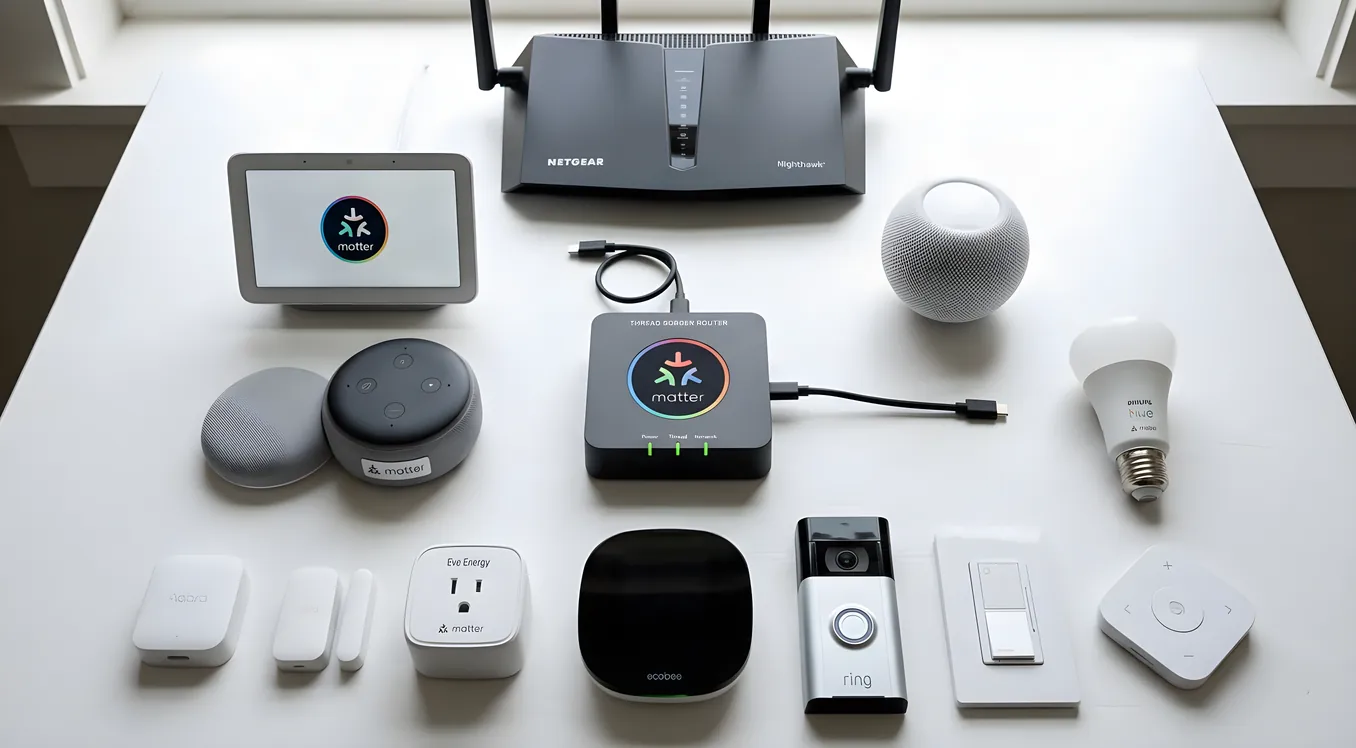
For years, the smart home industry operated like a trade war between competing empires. A Philips Hue hub talked to HomeKit. A SmartThings hub talked to Alexa. A Lutron Caseta system talked to almost everything, but only because Lutron wrote individual integrations for each platform. Buying a smart thermostat meant checking a compatibility matrix before you could buy a light switch.
The Matter smart home protocol was supposed to end that. Announced in 2019 under the name “Project Connected Home over IP” (CHIP) and first released as Matter 1.0 in October 2022, it promised a single standard that would let devices from any manufacturer work with any platform. Apple, Google, Amazon, Samsung, and hundreds of device makers signed on.
Three years into real-world deployment, the picture is more nuanced than the press releases suggested. Matter genuinely solves some things. It creates new complications in others. And Thread, the low-power networking protocol that runs alongside Matter, is quietly becoming one of the most significant infrastructure decisions in a modern smart home.
Here is what all of this actually means if you are planning, upgrading, or just trying to understand what you are buying.
The Problem Matter Was Built to Solve
Before Matter, smart home compatibility was a patchwork. Products carried logos indicating they worked with Alexa, Google Home, Apple HomeKit, or Samsung SmartThings, and those ecosystems did not share a common language. A device certified for Alexa might work with Google Home through a cloud-to-cloud bridge, introducing latency and a dependency on two companies’ servers staying online simultaneously.
The result was a consumer experience filled with edge cases. If your Z-Wave thermostat needed a hub, and that hub’s cloud went down, your automation stopped working at 2 a.m. If the manufacturer discontinued the hub app, your hardware became an expensive paperweight. Ring, Nest, ecobee, Lutron, Sonos: all of these companies built their own ecosystems and their own cloud dependencies, then layered integrations on top.
Matter’s core promise was a local, IP-based protocol that any certified device would speak natively. No cloud required for basic control. No per-manufacturer integration work. A Matter light bulb would appear in Apple Home, Google Home, Amazon Alexa, and Samsung SmartThings without any bridging.
What Thread Adds to the Equation
Thread is not the same as Matter. The distinction matters and creates a lot of confusion.
Thread is a mesh networking protocol designed for low-power devices. It operates on the 802.15.4 radio standard, the same underlying radio used by Zigbee, but it runs an IPv6 stack instead of a proprietary protocol. That IPv6 foundation is why Thread devices can participate in a local IP network directly, without a hub translating their proprietary signals.
Matter is the application layer. Thread is one of the transports it can run on. A Matter device might communicate over Thread, over Wi-Fi, or over Ethernet. Smaller battery-powered devices (sensors, buttons, locks) almost always use Thread because its mesh architecture and sleep modes allow months of battery life. Plugged-in devices often use Wi-Fi instead.
For a Thread network to function, you need at least one Thread Border Router: a device that bridges the Thread mesh to your regular IP network. HomePod mini, Apple TV 4K, Nest Hub Max, Eero Pro 6E, and several other devices contain Thread Border Routers. If you already have any of those in your home, you likely have a Thread Border Router running right now.
The practical consequence: if you buy Thread-based sensors or locks, their reliability depends on the density and placement of your Thread border routers. A single HomePod mini in the living room may leave a back-door lock without a reliable Thread path. This is a real deployment consideration that rarely appears in product marketing.
What Matter 1.0 Through 1.4 Actually Covers
The original Matter 1.0 specification covered a fairly limited device set: lights, switches, outlets, locks, thermostats, window coverings, TVs, and a handful of sensor types. That was enough to validate the protocol, but it left out the devices many people actually wanted to unify.
Matter 1.1 and 1.2 added energy management, refrigerators, dishwashers, and some network infrastructure categories. Matter 1.3 introduced energy reporting that lets devices report consumption back to controllers, a foundation for real-time energy dashboards. Matter 1.4, released in late 2024, expanded camera support significantly and added device location semantics that make room-based automation more reliable.
The device coverage still has gaps as of mid-2026. Sprinkler controllers, pool equipment, and most HVAC equipment beyond basic thermostats are either not yet specified or are in early implementation. Alarm panels are covered in specification but rarely in actual products. If your automation needs center on any of those categories, Matter does not meaningfully change your buying options yet.
Sonos added Matter support to its Era and Move 2 speakers in 2024, but the integration is limited: you can control power and volume through a Matter controller, but Sonos grouping, playlists, and multi-room audio require the Sonos app. This is a common pattern with Matter: manufacturers implement the base specification for the core functions, then keep their proprietary features in their own ecosystem. The “works with everything” claim is technically true but narrower in practice than it sounds.
How Major Platforms Handle Matter Differently
Amazon Alexa, Apple HomeKit, Google Home, and Samsung SmartThings all support Matter, but their implementations have different strengths.
Apple HomeKit was an early leader here. The Apple Home architecture was rebuilt to run Matter natively, and HomePod mini and Apple TV 4K serve as both Matter controllers and Thread Border Routers. If you are already deep in the Apple ecosystem, HomeKit’s Matter support is mature and local-first. The limitation is that Apple Home’s automation logic is comparatively simple. Complex conditional automations that high-end integrators build for Control4 Smart Home System: Complete Buyer’s Guide or Crestron require more powerful controllers with scripting environments, which Matter alone does not provide.
Google Home handles Matter reasonably well for basic control but has been slower on advanced automations and local processing. Google’s Nest ecosystem predates Matter, and the mapping between Nest’s cloud-based device model and Matter’s local model has created some rough edges.
Amazon’s Alexa Matter support works through the standard voice assistant interface but relies more heavily on Alexa’s cloud than competitors do. Routine triggers from Matter devices work, but latency in complex automations has been a consistent complaint.
Samsung SmartThings added Matter support and leans on its Hub v3 hardware as a Matter controller. SmartThings has the advantage of also supporting Z-Wave and Zigbee through the same hub, making it practical for homes with existing legacy devices.
The Multi-Admin Feature Nobody Talks About Enough
Matter’s “multi-admin” capability is one of its most practically useful features, and it gets less attention than it deserves.
With older smart home devices, a device was paired to one hub or ecosystem and essentially locked there. If you wanted your Ecobee thermostat in both Alexa and Apple Home, you depended on Ecobee having written integrations for both, and those integrations talked through the cloud.
Matter’s multi-admin allows a single physical device to be paired to multiple controllers simultaneously, each with independent local control. You can commission a Matter lock into Apple Home and Google Home at the same time. Both platforms control it locally without going through each other’s cloud. When you give someone a door code through Alexa, it reaches the lock directly, not via Apple’s servers.
This has real value for households with mixed platform preferences. It also means you are not locked into whatever controller you chose when you first set up a device.
Where Matter Still Falls Short
Matter genuinely simplifies the initial pairing and compatibility problem. It does not solve everything.
The specification defines what commands a device must support, not how sophisticated the controller can be. Matter-compatible devices still need a controller with the automation logic you actually want. If you want a presence sensor to adjust multiple lights based on time of day, occupancy state, and whether a specific person is home, Matter gives you the communication layer but not the logic engine. That logic lives in the controller, whether it is Apple Home’s automation editor, Google Home routines, or a more capable system like those used by professional integrators.
Firmware update consistency across manufacturers is another unresolved issue. Matter certification ensures devices speak the protocol, but it does not mandate how often manufacturers push security patches or how long they support a device. Buying a Matter device from a company with a history of abandoning products does not protect you just because it carries a Matter logo.
The onboarding experience, while better than it was in 2019, is still not frictionless. Scanning the QR code on a new Matter device and watching it provision into your home app takes about 60 to 90 seconds when it works. When it doesn’t, debugging requires knowing which transport the device is using, whether your Thread border router is reachable, and whether the commissioning controller is on the correct network segment. That troubleshooting is not consumer-friendly.
For custom automation at scale, the professional integration world has largely absorbed Matter as a lower layer rather than a replacement for their platforms. A system built on Savant Smart Home: What It Costs and What You Get still uses Savant’s proprietary control layer for complex scenes, sequencing, and media integration. Matter devices can appear in that system alongside Savant-native hardware, but the automation logic remains in Savant’s environment. The same is true for Crestron and other professional platforms.
Thread Border Router Placement in Practice
Because Thread forms a mesh, every Thread device with mains power (plugged-in, not battery-powered) becomes a Thread router that extends the network for other devices. Battery-powered devices are end nodes only. This means a home with several Thread-capable smart plugs distributed across rooms will have a much more robust Thread mesh than a home that only has two HomePod minis.
Rough guidance for planning:
A single Thread border router handles a small apartment or a home with fewer than a dozen Thread devices comfortably. A 2,500 square foot home with mixed-floor Thread devices should plan for two to three border routers placed to provide overlapping coverage, particularly through concrete or brick walls that attenuate 2.4 GHz signals. Large homes or those with significant RF obstruction should treat Thread border router placement with the same care as Wi-Fi access point placement.
The Eero Pro 6E and Eero Max 7 both include Thread Border Routers, making them worth considering if you are planning a Wi-Fi upgrade alongside a Matter deployment. You get Wi-Fi access points that simultaneously extend your Thread mesh, which reduces the number of separate devices you need.
What This Means for Existing Zigbee and Z-Wave Systems
Matter does not make Zigbee and Z-Wave obsolete, and it is not trying to. Both protocols have enormous installed bases and large catalogs of devices. Matter explicitly supports bridging: a Zigbee hub can present its connected devices to a Matter controller as if they were native Matter devices, which is exactly what Philips Hue, IKEA, and others have done.
If you have an existing Zigbee or Z-Wave system that is working well, Matter does not require you to replace anything. It means your existing hub can expose those devices to a wider range of controllers, and any new devices you add might be Thread-based instead of requiring the hub at all.
The transition will be gradual. Zigbee has an enormous device catalog at competitive price points, particularly for sensors and specialty hardware, that Thread has not yet replicated. A Zigbee door/window sensor might cost $15 with a three-year battery life. Comparable Thread sensors are catching up but still carry a price premium in many categories.
The Professional Integration Perspective
The highest-end residential automation platforms, including those mentioned in the Crestron Home Automation: Enterprise-Grade for Residential category, treat Matter as one input source among many rather than a foundational shift. A Crestron or Control4 dealer building a $100,000 system is not going to replace their control processors with a Matter controller. They will add Matter bridges that let their platforms absorb Matter devices alongside proprietary hardware.
For voice control specifically, systems like Josh.ai: The Privacy-First Voice Control System operate at a layer above the protocol. Josh.ai integrates with Matter devices, Lutron Caseta and RadioRA, proprietary audio systems, and custom integrations simultaneously. The voice experience and privacy architecture Josh provides are independent of whether the underlying devices speak Matter or a proprietary protocol.
The practical takeaway for homeowners evaluating professional systems: ask how the integrator handles Matter devices, not whether they support Matter as a point of pride. A good integrator will give you a clear answer about which device categories they are currently sourcing as Matter, which they are keeping as proprietary, and why.
Buying Guidance for 2025 and Beyond
If you are buying smart home devices today, here are the cases where Matter meaningfully changes your decision:
Lights and switches: Matter-certified bulbs and switches from Signify (Philips Hue), IKEA, Eve, and others now offer genuine platform flexibility. Buying a Matter light switch means you can move it between ecosystems if you change controllers, something you could not do before. For new installations, Matter-certified switches are worth the slight price premium if you want to keep your options open.
Locks: Thread-based Matter locks from Schlage (the Encode Plus supports Matter) and others provide local control and multi-admin flexibility. Verify your Thread coverage before installing a Matter lock on a back door that is 60 feet from your nearest border router.
Sensors: This is where Thread’s battery life advantage over Wi-Fi matters most. A Thread door sensor that runs two years on a CR2032 is meaningfully better than a Wi-Fi sensor that needs recharging every few months. Shop for Thread-based sensors specifically if you are deploying more than five or six sensors.
Thermostats: Ecobee added Matter support to its SmartThermostat Premium. Nest Thermostat also supports Matter. For most homeowners, this means you can commission these into your preferred ecosystem without a cloud bridge, which improves reliability.
Cameras: Matter 1.4 improved camera support substantially. Eve Outdoor Cam and some newer Ring cameras support Matter. The integration is still primarily for live view and motion events; recording, history playback, and platform-specific features remain in each manufacturer’s app.
What to skip on Matter: If a device category you need is not well-specified in the current Matter standard, buying a non-Matter device from a brand with good ecosystem support (Lutron Caseta for lighting, ecobee for thermostats, Ring for security) is still the right call. Do not wait for Matter to cover categories that are years away from solid specification.
Getting the Infrastructure Right First
The single most important practical lesson from early Matter deployments is that the network infrastructure needs to be right before the devices go in. Matter devices rely on stable local networking, and Thread devices rely on adequate border router coverage.
Before buying Matter or Thread hardware: confirm your Wi-Fi network is stable and segmented appropriately (a separate IoT VLAN is useful but requires a router that supports it, like an Eero or UniFi system), identify where your Thread border routers will live, and understand which controller will serve as your primary Matter controller.
This is not dramatically different from what good smart home planning has always required. Matter does not replace the need for thoughtful infrastructure planning. It does make the device layer more flexible once that infrastructure is in place.
The Honest Long-Term Picture
Matter is real progress. It is not a revolution, and it is not the product of marketing. The protocol solves actual fragmentation problems that previously required manufacturers to write individual integrations for each platform. Multi-admin is genuinely useful. Local control reduces cloud dependency in a meaningful way.
What Matter does not do: replace a capable control system with sophisticated automation logic, guarantee long-term manufacturer support, or make the smart home setup process foolproof.
The homeowner who benefits most from Matter is someone who wants flexibility to choose devices from different manufacturers without being locked into one ecosystem, values local control over cloud reliability, and is willing to think about Thread border router placement alongside Wi-Fi planning.
For everyone else, the practical advice is simpler: buy from manufacturers with good track records on software support, treat Matter certification as a useful quality signal without treating it as the only signal, and make sure your network infrastructure is solid before adding more devices to it. Those principles were true before Matter, and they remain true after it.