Smart Intercom Systems: Room-to-Room and Door Communication
Before the smartphone, a whole-house intercom was a luxury reserved for large estates and commercial buildings. A wired NuTone or Aiphone panel in every room, a master station in the kitchen, and a door station out front. The systems worked well but cost a lot to install, aged poorly, and offered nothing beyond two-way audio.
Today the category has split into several distinct product types that solve different problems at different price points. A $250 Ring Video Doorbell and a $15,000 Control4 intercom system are both technically “smart intercom systems,” but they address almost nothing in common. Knowing which product type matches your actual problem is the whole job, and most homeowners never get clear guidance on that distinction before spending money.
This is that guidance.
What Problem Are You Actually Trying to Solve?
The right starting question isn’t “which intercom should I buy?” It’s what communication failure are you trying to eliminate?
The scenarios cluster into three distinct use cases, and the product architectures that solve each one are genuinely different.
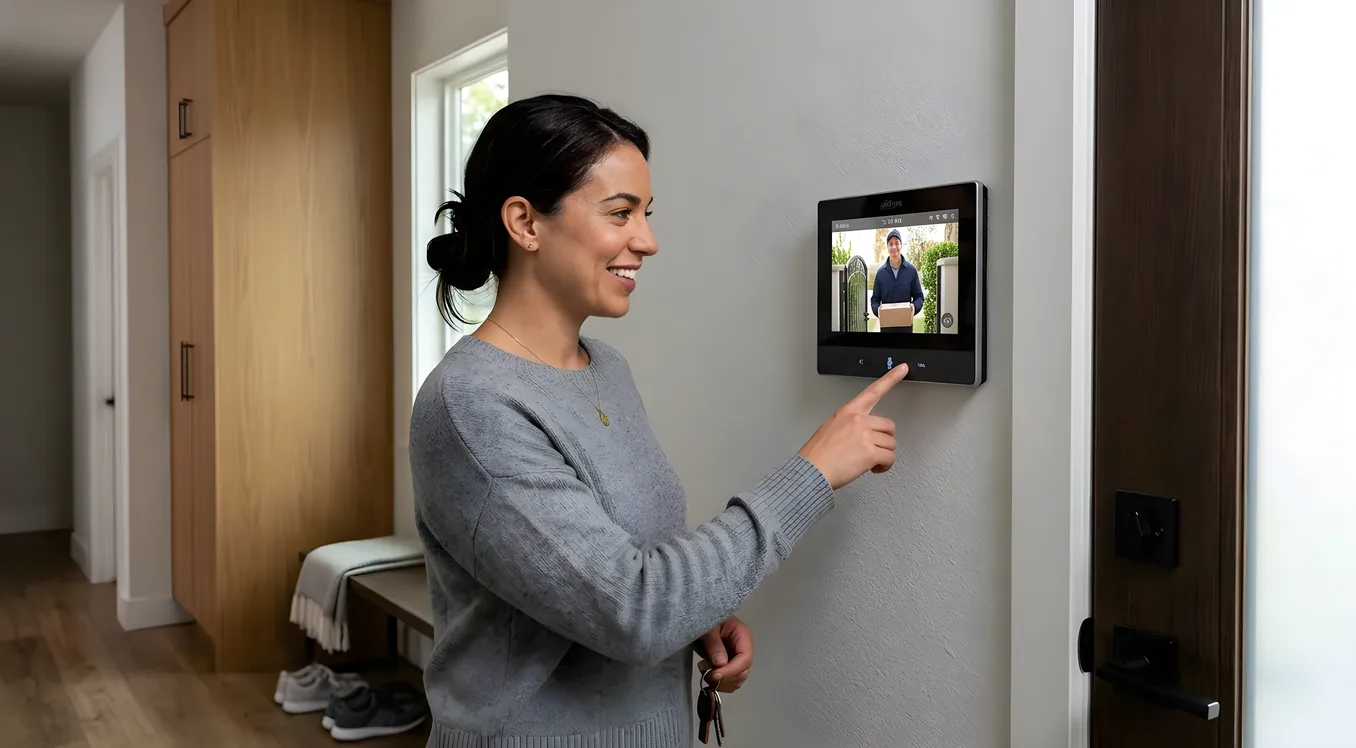
Door monitoring and visitor communication is the most common need. Someone rings the bell, you want to see who it is and talk to them without opening the door or even being in the same room. Video doorbells solve this. So do dedicated door stations paired with indoor panels. The product selection depends on whether you want basic notification plus video or full two-way audio-video with call routing to multiple indoor stations.
Room-to-room communication is the second use case. Large homes where calling out across the house doesn’t work. Multi-story houses where a parent wants to reach kids upstairs without walking up. Households with older family members who may not always have their phone. The NuTone-style whole-house intercom was built for this, and modern equivalents exist at every price point.
Integration with a broader smart home system is the third. When you already have a Control4, Savant, or Crestron system, you probably want the intercom to be a native part of it, showing video on your touchpanels, routing calls through your whole-house audio zones, and triggering door locks when you grant access. This is a different product category than a standalone smart doorbell.
Door Stations and Video Doorbells: Where Most People Start
For the door communication problem, the market now has two main tiers.
Consumer Video Doorbells
Ring, Nest (now Google), and Arlo dominate this space. They solve a real problem cheaply and with no professional installation required.
The Ring Video Doorbell Pro 2 ($230) shoots 1536p video with a 150-degree horizontal by 150-degree vertical field of view, which is wide enough to see packages left on a porch. It uses radar-based motion zones to reduce false alerts, connects to 2.4GHz or 5GHz Wi-Fi, and requires hardwired installation (no battery). The app lets you answer the door from anywhere with a smartphone. Two-way audio works well. If you have Amazon Echo devices, they can serve as indoor chimes and display the doorbell feed on Echo Show screens.
Google Nest Doorbell (wired, $180) integrates naturally into a Google Home ecosystem and supports Familiar Face detection, which lets you know if the person at your door is a recognized household member or a stranger. The Nest Doorbell sends clips to Google Drive with a Nest Aware subscription ($6/month for 30 days of video history or $12/month for 60 days).
The meaningful limitations of this tier: cloud dependency (if Ring or Google’s servers have an outage, your system may not work), video stored off-premises (a privacy and security consideration), and no clean integration with professional control systems. They’re also single-point installations. The door station communicates to your phone, not to a panel in the kitchen or a touchscreen in the master bedroom.
Professional Door Stations
When you need the door station to connect to an indoor panel, to an existing home automation system, or to multiple call destinations, you need a different class of product.
Aiphone has made commercial-grade intercom systems for decades. The Aiphone JO-1FD ($280) door station pairs with indoor panels that support full-duplex audio and video. Their IX Series is IP-based, running over Cat5e or Cat6, and supports SIP protocols, which means they can connect to a broader VoIP or smart home infrastructure. An IX-DVF-RA door station ($380) handles facial recognition and connects to IX-MV7 ($450) touchscreen indoor panels.
2N Telecommunications (owned by Axis) makes the 2N IP Verso, a modular door station platform used widely in commercial and high-end residential. Starting around $300 for a basic IP video station, the Verso accepts plug-in modules for RFID card readers, fingerprint scanners, and Bluetooth. It runs over IP, integrates with Control4 drivers, and supports RTSP streaming to NVRs. This is the door station you specify when the project already has a network video recorder and a professional control system.
Whole-Home Room-to-Room Systems
This category splits between legacy-style wired systems and modern IP-based platforms.
Wired Panels
NuTone and Leviton have made traditional wired intercom panels for decades. A NuTone IM-3303WH ($200) master station with multiple IMA-3303WH room stations ($80 each) gives you room-to-room calling and an AM/FM music distribution function. Wiring runs from a central master station to each room, requiring 18/4 or 22/4 wire. If your home was built between the 1960s and 1990s, there’s a reasonable chance this infrastructure is already in your walls.
These systems are reliable and inexpensive to replace like-for-like. They’re also limited. No video, no smartphone integration, no cloud connectivity, and no ability to pull into a modern control system.
If you have a large home with existing wired intercom infrastructure and want to upgrade it without a full retrofit, Leviton’s HAI Omni panels support integration with their legacy wired intercom systems while adding smart home control. That’s a specific use case, but it’s worth knowing it exists.
IP-Based Intercom Platforms
The more interesting modern option is an IP intercom platform that runs over your home’s Cat6 network. These systems use the same physical infrastructure as your data network and support video at every station.
Comelit makes the ViP ($350-$500 per station) series, which runs over IP and supports video calls between any stations on the network. Fermax, another European manufacturer, offers similar architecture. These systems connect to central panels, support mobile app integration so your phone can receive calls when you’re away, and in some configurations integrate with third-party smart home systems.
For homes that want something closer to commercial-grade intercom with high visual quality, the Aiphone IX-MV7 ($450) 7-inch touchscreen panel with IX-DV door station runs over IP and supports true video intercom between all stations. The IX system supports connection to a SIP server, which enables integration with systems like Crestron or Control4 that have SIP drivers.
Professional Control System Integration
If your home has a Control4, Savant, or Crestron system (or you’re planning one), the intercom function becomes part of a larger architecture, and the product selection criteria change.
Control4
Control4 integrates with several IP door stations via certified drivers. The most common pairing is a 2N IP Verso or Aiphone IX door station connected to a Control4 system via their Intercom Anywhere feature. When someone rings the door station, it shows up as a call on Control4 touchpanels (the T3 Series starts around $700 for a 7-inch panel), on Control4 Neeo remotes, and in the Control4 app on smartphones. You can answer, see the video feed, and trigger a door lock relay from any of these devices.
Control4 also supports room-to-room calls between T3 panels in a whole-home system. In a home with T3 panels in the kitchen, master bedroom, and great room, any panel can initiate a video call to any other panel. This is the same function as a traditional whole-house intercom, built into the touchpanel infrastructure you’re already paying for.
The cost of this approach scales with the Control4 system itself. A basic Control4 system with three touchpanels, a door station, and intercom functionality might be $8,000 to $14,000 installed. A full whole-home Control4 system with 8+ panels, a professional door station, and integrated access control (locking and unlocking a smart door lock when you answer a call) can run $25,000 to $50,000 or more.
Savant
Savant’s approach to intercom follows similar logic. Savant panels (the Pro Remote and Savant Home app) receive notifications from IP door stations and support room-to-room communication between Savant touchpanels. Savant also integrates with the whole-house audio systems they support, so a door ring can pause your music, announce across the house, then resume when the call ends. That kind of coordination is why homeowners with large custom systems pay for professional integration rather than adding standalone products.
Crestron
Crestron’s TSW touchscreen series (the TSW-770 is a popular 7-inch model, around $1,100 list price) supports SIP-based video calling natively. Pair it with a SIP-compatible door station like the 2N IP Verso or a Grandstream video door station, and you get full video intercom with the door station displayed on every Crestron touchpanel in the home. Crestron also supports integration with enterprise-grade distributed video systems, so a door camera feed can route to any display in the house.
Apartment and Multi-Unit Considerations
Smart intercom for multi-unit buildings (duplexes, ADUs, homes with detached guest houses) follows different rules than single-family installations.
For a main house with a detached ADU, a solution like the Doorbird D2101V ($380) network video door station paired with a SIP app on smartphones gives both units independent communication with the front door, with call routing that can ring the main house, the ADU, or both simultaneously based on rules you set.
For apartment buildings (a property owner managing multiple units), IP intercom platforms like ButterflyMX ($3,000 to $6,000 for a full building installation) or Avigilon Alto (commercial-grade, priced by project) handle tenant management, temporary access codes, package deliveries, and video logs at the building entry.
Wired Versus Wireless: Which Architecture Holds Up
The choice between wired and wireless intercom comes down to use case and installation stage.
Wired systems (running on Cat6, coaxial, or dedicated 18/4 intercom wire) offer the most reliable performance. No Wi-Fi interference, no packet loss, no battery replacement cycles. If you’re building a new home or doing a substantial renovation with walls open, wiring dedicated home runs to every intercom station location costs $50 to $150 per run in materials and relatively little incremental labor. Cat6 runs from a central switch to each panel location give you maximum flexibility and let you use IP-based panels from any manufacturer.
Wireless systems (Wi-Fi or proprietary RF) make sense for retrofit installations where running new wire is prohibitively expensive or disruptive. Ring, Google Nest, and similar products fall here. The tradeoff is Wi-Fi dependency. Video doorbells in particular put high bandwidth demand on your wireless network, and in a home with a congested 2.4GHz band, performance can be erratic. A dedicated 2.4GHz or 5GHz SSID for smart home devices, or a mesh system with a dedicated IoT network, reduces this problem significantly.
For outdoor intercom stations specifically, weatherproofing becomes a specification requirement. Products rated IP65 or higher handle rain and dust exposure. IP55 is the minimum for covered outdoor locations. Uncovered outdoor stations in climates with direct sun, freezing temperatures, or high humidity need IP65 or better and operating temperature ratings that match your local conditions. Most professional-grade door stations like the 2N Verso and Aiphone IX-DVF meet IP65. Consumer video doorbells generally rate IP44 to IP55.
If your home’s outdoor spaces include areas beyond the front door, outdoor audio and video systems often incorporate outdoor display and intercom functions as part of a broader weatherproof installation.
Cost Summary: What to Expect at Each Level
Budget for intercom projects varies enormously based on product tier and installation scope. These ranges assume professional installation for anything beyond a consumer video doorbell.
Consumer video doorbell only (DIY-installed): $180 to $350 for the device. No installation cost if you’re replacing an existing wired doorbell. Add $150 to $250 for electrician time if you’re adding a transformer or running new low-voltage wire.
Standalone IP intercom with door station and 2-3 indoor panels: $1,500 to $4,000 installed, using products like Aiphone or 2N with IP panels. This gives you video at the door, room-to-room calling, and typically a smartphone app for remote answering.
Integration with a professional control system (Control4, Crestron, Savant): $3,000 to $8,000 added to an existing system, assuming panels are already in place. Higher if new touchpanels are needed. This tier includes door station integration, whole-home call routing, door lock control, and music pause/resume on door ring.
Full whole-home intercom with video at every room station: $8,000 to $20,000 for 6-10 stations with IP video, central system integration, and smart lock control. Systems like this are typically part of a larger AV integration project.
Things That Go Wrong (and How to Avoid Them)
Two mistakes show up repeatedly in smart intercom projects.
Buying for the door problem but ignoring the panel question. A Ring Doorbell is a good product for what it does, but if you later want the door call to ring an indoor panel in the kitchen rather than just your phone, you’re looking at a complete product replacement. If there’s any chance you’ll want whole-home call routing in the next five years, plan for an IP intercom platform now, even if you start with just the door station and add panels later.
Spec’ing the wrong outdoor rating for the climate. An IP44-rated video doorbell in a wet Pacific Northwest installation or a Texas summer with direct western exposure is going to fail earlier than the manufacturer’s stated lifespan. Specify IP65 outdoors unless the installation is under a deep covered porch with significant protection from direct weather.
Ignoring the network. IP intercoms put video traffic on your home network. A 1080p intercom call isn’t the same bandwidth load as a 4K streaming session, but in a home with many cameras, panels, and other networked devices, a poorly designed Wi-Fi network or an unmanaged switch with traffic prioritization issues will cause audio and video artifacts during calls. This is especially relevant when intercom panels are part of a system that also includes in-ceiling speakers and networked AV distribution.
Choosing What’s Right for Your Home
The pattern that holds across almost every intercom project: the right scope is usually one tier higher than what a homeowner initially considers, because the installation cost of running wire and the disruption of adding panels later is always more expensive than doing it right the first time.
For a new home build or major renovation, spec Cat6 home runs to every intercom location during framing, even if you’re not sure which system you’ll install. The wire cost is negligible relative to the flexibility it buys.
For a retrofit, the deciding factor is usually how many rooms you want to reach and whether smartphone-only answering is acceptable. If you can live with a phone notification and a video feed on the Ring app, a consumer doorbell solves the door problem for under $300. If you want a panel in the kitchen that you can glance at and answer without touching a phone, plan for an IP intercom system and budget $2,000 to $4,000 for a quality installation.
And if you’re already planning a Control4, Crestron, or Savant system, the intercom function is almost always worth folding in. The incremental cost is modest relative to the system investment, and the integration quality that a professional control system provides, music pausing on door ring, video routing to any display, access control from any touchpanel, is something a standalone intercom product simply cannot replicate.
Start with the communication problem you’re actually trying to solve, match it to the right product tier, and plan the infrastructure to support one level of growth beyond where you are today.