Vinyl and Turntable Integration with Whole-House Audio
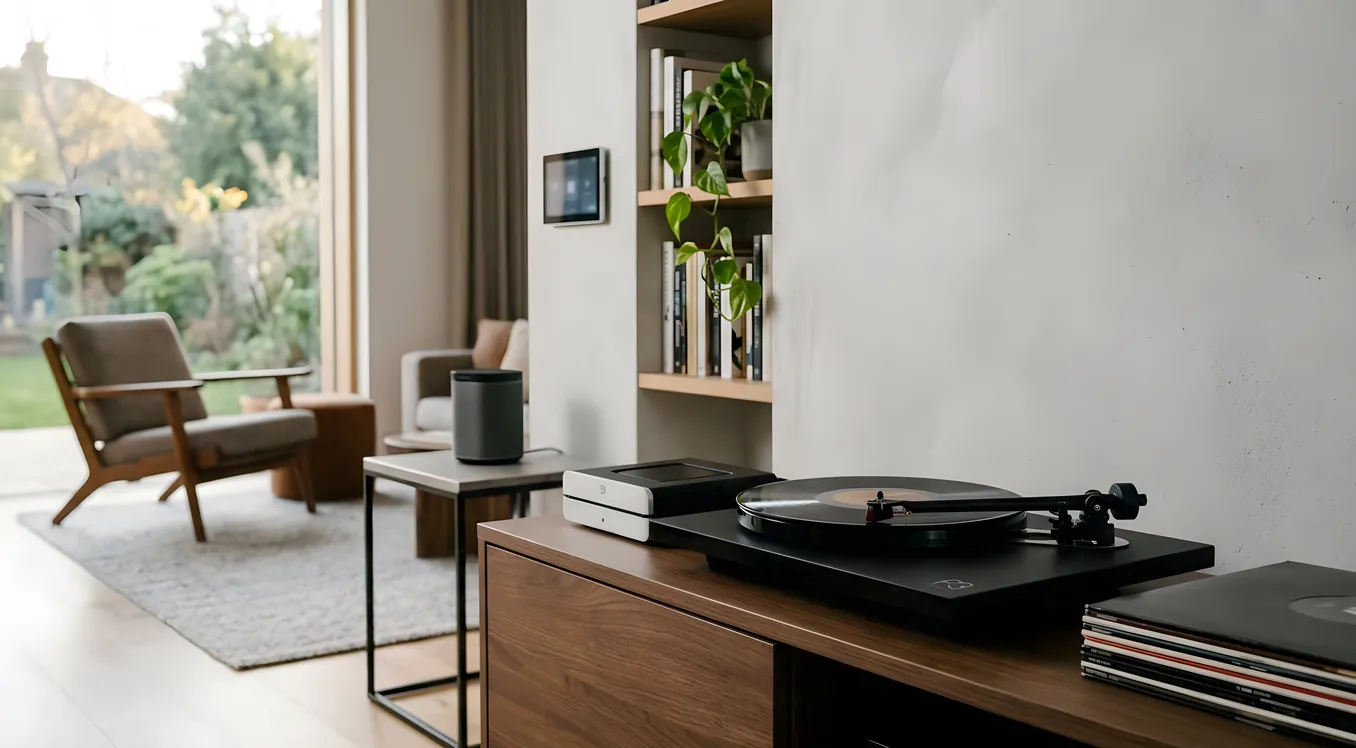
There is a specific frustration that vinyl enthusiasts run into when they start building out a smart home: the rest of the house can stream anything from anywhere, but the turntable is stuck in one room. You buy a record, you sit in the listening room with it. The kitchen, the back patio, the bedroom, the backyard all stay silent. Meanwhile, a phone with a streaming app can push music anywhere in seconds.
This is not a niche problem. Vinyl sales have grown every year since 2006, and a large portion of the people buying records are the same people investing in whole-house audio infrastructure. Integrating a turntable with a distributed audio system is technically solvable, but it requires understanding why analog sources behave differently from digital ones, and what each integration path costs you in terms of signal quality, latency, and control.
This article is for the homeowner who already has, or is planning, a distributed audio system and wants to include their turntable as a source that can play to any zone in the house. It covers the signal chain, the integration methods for Sonos, Control4, Savant, and Crestron, and the real tradeoffs between them.
Why Turntables Are Harder Than Streaming Sources
A streaming source, whether a Sonos app, an Apple TV, or an Ethernet-connected streamer, produces a digital signal that a whole-house system can route, buffer, and synchronize without any signal degradation. You can send that same bitstream to twelve zones simultaneously and every zone gets an identical copy.
A turntable is an analog source. The cartridge converts physical groove vibrations into an electrical signal that is both extremely low in voltage (typically 0.2 to 5 millivolts depending on cartridge type) and filtered with the RIAA equalization curve: bass frequencies are attenuated during recording and must be boosted back up during playback, while treble is compressed during recording and must be attenuated during playback. This is done so that grooves do not need to be carved so wide that only a few minutes of music fits on a side.
Before a turntable signal can enter any audio system, it must pass through a phono preamp (also called a phono stage) that applies the inverse RIAA curve and boosts the signal to line level. Some turntables have this built in. Most serious ones do not, because a built-in phono stage is a cost and component compromise. Without a phono preamp in the signal chain, a turntable connected to a line-level input sounds thin, quiet, and tonally wrong.
The second challenge is latency. Every digital processing step adds a tiny delay. A streaming system can compensate for this because both the source and the destination are digital and the buffer can absorb the delay. But if you are listening to a turntable through a distributed system while also being in the same room as the speakers that are receiving the signal after digital conversion, you may notice lip-sync issues or a slight echo effect from the room itself. This is a real constraint that affects integration method choices.
The Signal Chain Before You Think About Distribution
Get the signal chain right before worrying about distribution. A phono preamp is non-negotiable unless your turntable has one built in, and even then, an outboard phono stage almost always sounds better.
For a turntable being used as a whole-house source, a standalone phono preamp in the $150 to $500 range is appropriate. The Pro-Ject Phono Box S3 ($299) and the iFi Zen Phono ($149) are both widely respected in this price tier. If you are running a moving coil cartridge (lower output, used on higher-end tables), you need a phono stage that explicitly supports MC input, such as the Vincent PHO-500 ($349) or the Graham Slee Gram Amp 2 SE ($349).
The signal path looks like this: turntable cartridge → tonearm cable → phono preamp → line-level output → whatever the distributed system can accept as an analog input.
What the distributed system can accept is where the different integration paths diverge.
Integration Path 1: Sonos with an Analog Input
Sonos is the most common whole-house audio platform in mid-range residential installations, and it does have a path for analog sources. The Sonos Port ($449) and the now-discontinued Sonos Connect both include a line-level RCA analog input. You connect your turntable’s phono preamp output to the Port’s analog input, and the Port digitizes the signal and makes it available as a Sonos source across your whole system.
This works, and it is the simplest integration path if you are already on Sonos. But there are two things to understand before you do it.
First, the Sonos digitization process introduces latency, typically 70 to 100 milliseconds. If you are playing your turntable in the room where the Port is located and also listening through a Sonos speaker in that same room, you will hear the physical sound from the speakers (happening at the speed of sound) slightly before or after the Sonos-processed signal, creating a phasing or echo artifact. The workaround is to either not use a Sonos speaker in the same room as the turntable, or to use a Sonos Amp connected directly to passive speakers in that room with the output set as the primary source so no digitization delay is added to the room feed.
Second, the Sonos Port converts analog input at 44.1 kHz / 16-bit, which is CD-quality. This is genuinely fine for vinyl, and the argument that you are losing audiophile fidelity by digitizing at 16/44.1 is mostly theoretical given the noise floor of most listening environments. But if you have a high-end cartridge and phono stage and you are trying to maximize fidelity in the primary listening room, you may prefer a parallel path where that room gets the analog signal directly while Sonos distributes it everywhere else.
For a straightforward Sonos installation where the turntable is a secondary source used mostly in the kitchen and back patio, the Sonos Port approach costs about $449 for the Port plus the cost of the phono preamp ($150 to $300), so roughly $600 to $750 all-in. The Whole-House Audio Systems: Distributed Sound Done Right article covers Sonos architecture in depth if you want context on how the Port fits into a larger Sonos installation.
Integration Path 2: Control4 or Savant with an Audio Matrix
Custom-installed whole-house audio systems built around Control4 or Savant use a different architecture. Rather than a mesh of self-powered wireless speakers, these systems typically include a central matrix amplifier (such as the Control4 Triad Multi-Zone Matrix Amplifier Series or a Crown or QSC commercial matrix amp) that distributes analog or digital signals to passive in-wall and in-ceiling speakers throughout the home.
These systems accept analog line-level inputs at the matrix level. You connect the phono preamp output to a line-level input on the matrix, name it “Turntable” in the Control4 or Savant programming, and that source becomes available in any zone in the system. A homeowner can select “Turntable” from the touch panel, app, or in-wall keypad in any room and hear the record playing in any zone or all zones simultaneously.
The latency problem exists here too. Most matrix amplifiers convert analog inputs to digital for internal routing, then convert back to analog at the speaker output. Depending on the amplifier, this introduces 5 to 40 milliseconds of delay, which is substantially less than the Sonos Port’s 70 to 100ms but still present. High-end matrix amplifiers from QSC and Crown designed for live performance applications introduce as little as 1 to 2 milliseconds, which is genuinely inaudible.
Control4 systems are priced project by project, but a common benchmark is $1,500 to $3,000 for the audio integration portion of a multi-zone project, not including the matrix amplifier hardware, which ranges from $800 for a 4-zone unit to $4,000 or more for a 16-zone unit from Triad. The turntable itself is just another analog source and adds no meaningful cost beyond the phono preamp. The Sonos vs Custom-Installed Audio: Convenience vs Performance article covers this architecture comparison in more detail.
Savant’s architecture is similar to Control4 in this respect. The Savant RIO A/V router accepts analog inputs and makes them available across the Savant ecosystem. Savant installations typically run at a higher price point overall, partly because of the platform and partly because Savant dealers tend to target higher-end residential projects.
Integration Path 3: Crestron with a Digital Audio System
Crestron whole-house systems are common in large custom homes and commercial-grade residential projects. Crestron’s audio distribution products, particularly the SWAMP (Streaming Audio Matrix Presentation) family and the DMPS (Digital Media Presentation System) platform, route audio across IP networks. Analog sources can be connected via Crestron’s analog input modules (such as the HD-RXC-4KZ-HDBT input card) and converted to the Crestron AV-over-IP framework.
Crestron integration for a turntable source works the same way as Control4: the phono preamp output goes into an analog input on the Crestron system, and programming exposes it as a named source in the UI. The difference is in system scale and programming complexity. Crestron is almost always installed and programmed by a certified dealer (a Crestron Authorized Dealer, or CAD). Custom programming for a Crestron system can run $2,000 to $6,000 just for the programming labor, which is why Crestron is typically found in $500,000+ projects where that cost is proportionate to the overall investment.
If you are building a Crestron system and want turntable integration, mention it explicitly to your dealer during the design phase. It is a trivial addition if planned from the start and a nuisance if retrofitted later because it may require changes to the programming that was already written and tested.
Keeping the Primary Listening Room Analog
Most vinyl enthusiasts who want whole-house turntable distribution also have a primary listening room, a dedicated two-channel setup or a home theater with serious speakers, where they do their focused listening. The integration challenge is letting that room stay fully analog (no digitization, no latency) while also feeding the distributed system for casual playback.
The solution is a signal splitter in the analog domain. After the phono preamp, you run the signal through an RCA Y-splitter or a dedicated analog distribution amp. One output goes directly to the primary listening room’s amplifier or receiver via a traditional analog connection. The other output goes to the Sonos Port, Control4 matrix input, or Crestron analog input for distribution.
This way, the listening room is getting the raw analog signal with no digital conversion in the path at all, while the distributed system gets a copy of the same signal. The two paths operate independently. If the primary listening room has in-ceiling speakers on the Control4 or Crestron system, you would exclude those from the turntable source assignment and drive them through the dedicated analog path separately.
For the split to work cleanly, you need to make sure the two loads on the phono preamp output are within its rated output impedance. Most outboard phono stages can handle a 10 kOhm load without any issue, and a standard passive Y-splitter with two 10 kOhm inputs on each branch will work fine. If the phono stage has a particularly high output impedance (over 1 kOhm), a small buffer amp in the $100 to $200 range (such as the Emotiva BT-100 or a Schiit SYS passive preamp) can prevent loading artifacts.
The Outdoor Zone Question
Turntable playback for outdoor zones is a frequently overlooked use case, but it is a genuinely compelling one. Playing records on a summer evening with the music extending out to the patio or backyard is exactly the kind of seamless experience whole-house audio is meant to enable.
The integration method for outdoor zones is the same as any other zone: the turntable signal goes through the distributed system and can be assigned to outdoor speaker zones. The hardware considerations for the outdoor zones themselves are separate. Outdoor Audio and Video: Weatherproof Entertainment Systems covers weatherproof speaker options and amplification for outdoor zones.
One practical note: outdoor speaker zones often run on a separate amplification circuit or are served by a dedicated weather-resistant amp, such as the Sonance Landscape Series or a Polk Audio Atrium 6 setup. These zones can receive the turntable source from the same matrix or Sonos system feeding the interior zones without any special handling.
Record Skips and Live Playback Considerations
A practical reality of integrating a turntable with a distributed system: if the record skips, the skip plays through every active zone simultaneously. This is not a problem with streaming sources because those buffer ahead. It is worth knowing before you set up a dinner party and put a record on.
Similarly, records have sides. A 33 RPM LP has roughly 20 to 25 minutes per side. Someone has to be in the room to flip the record. If you walk out to the patio and the record ends, the system goes silent until someone flips it. This is obvious but it is the kind of thing that resets expectations around vinyl as a distributed source: it is best used as an immersive listening experience for shorter periods, not as background music for an entire evening without attention.
Automatic turntables like the Pro-Ject Automat A1 ($499) and some of the Audio-Technica AT-LP series models stop and return the tonearm at the end of a side, which prevents the stylus from riding the lock groove indefinitely and extends stylus life. This matters more when the turntable is playing in a room where no one is watching it, which is exactly the whole-house distribution use case.
Practical Setup for a New Installation
If you are starting from scratch and want turntable integration as part of a new whole-house audio system, here is a realistic budget and component framework for a 6-zone system:
Sonos-based path (6 zones):
- Turntable of your choice (existing or new): $300 to $2,000+
- Outboard phono preamp: $150 to $300
- Sonos Port for analog input: $449
- Sonos Era 100 or Era 300 units for 3 wireless zones: $750 to $1,350
- Sonos Amp for 3 zones with passive in-ceiling speakers: $2,100
- In-ceiling speakers (6 pairs, mid-grade): $900 to $1,800
- Professional installation (wiring, mounting, calibration): $1,500 to $3,000
- Total range: $6,150 to $9,000
Control4-based path (6 zones):
- Turntable: $300 to $2,000+
- Outboard phono preamp: $150 to $500
- Control4 EA-1 or EA-3 controller: $1,000 to $2,500
- Triad 6-zone matrix amp: $1,800 to $2,500
- In-ceiling speakers (6 pairs, Polk Audio Reserve or Klipsch): $1,200 to $2,400
- Professional installation and programming: $3,000 to $6,000
- Total range: $7,450 to $13,900
The Control4 path offers tighter integration with lighting, shading, and whole-home control via Control4 keypads and the Control4 app. It also gives you better low-latency performance for the primary listening room if you design it correctly. The Sonos path is simpler to manage and has a lower entry cost. In-Ceiling and In-Wall Speakers: Invisible Audio for Smart Homes covers the speaker hardware selection in more detail.
Getting the Most From Vinyl in a Distributed System
A few things that make turntable whole-house audio work better in practice:
Use a manual volume control in the listening room. The distributed system handles volume per zone, but the phono preamp’s output level sets the input gain for the entire system. If the phono preamp runs too hot, every zone will clip at moderate volumes. Most matrix amps have per-input trim controls. Set them during commissioning with the turntable playing a moderately loud passage.
Label the source clearly in your UI. In Control4 or Savant, name the source “Turntable” with a record icon. This matters because someone unfamiliar with the system needs to understand that this source is live and one-way. They cannot pause it, skip tracks, or control it from the app.
Consider a turntable in a dedicated equipment room. If your home has an AV equipment closet or rack room, locating the turntable there (with a good vibration-isolated shelf) and running the signal to the phono preamp and then the matrix from there simplifies the wiring. The tradeoff is that you cannot watch the record play, which some people find is half the point.
Do not connect a turntable to a digital-only input. Some modern matrix amps have only AES/EBU or S/PDIF digital inputs. An analog-to-digital converter (ADC) is required in these cases. The Behringer U-PHONO UFO202 ($29) is a functional if low-fidelity option; the Audient iD4 MKII ($199) is a significant step up and appropriate for a more serious system.
When to Bring In a Professional Integrator
If you are running a Sonos system and adding a Port for analog input, this is a DIY-friendly project. The wiring is RCA-to-RCA, the Port is plug-and-play in the Sonos app, and the setup takes about an hour.
If you are incorporating turntable playback into a Control4, Savant, or Crestron system, a certified integrator is not optional. These systems require custom programming that most homeowners cannot do themselves, and incorrect configuration can affect the entire system. Programming changes on existing Control4 or Crestron systems typically run $150 to $250 per hour, and a turntable integration might take 2 to 4 hours including testing, so budget $300 to $1,000 for the programming work if you are adding to an existing system.
The good news is that any qualified integrator who has done this before will find the turntable integration straightforward. Analog line-level sources are well-understood. If an integrator acts like this is an unusual or difficult request, ask them how many analog source integrations they have done recently and whether they are familiar with phono stage impedance matching. The answers will tell you a lot.
Playing Records Through Every Room
Integrating a turntable with whole-house audio is not a workaround or a compromise. It is a first-class integration that treats vinyl playback with the same seriousness as any streaming source in the system. Done correctly, the experience of selecting “Turntable” from a Control4 panel and hearing a record play through the kitchen and patio speakers while the living room gets the direct analog feed is exactly what distributed audio is supposed to make possible.
The key decisions are: which phono preamp matches your cartridge, whether to use Sonos or a custom matrix system as your distribution backbone, how to handle the primary listening room so it stays analog, and whether to split or route for the outdoor zones. Get those decisions right in the design phase and the installation is straightforward. Try to retrofit them afterward and you will spend more money solving problems that would not have existed with an hour of planning at the start.