Smart Irrigation: Weather-Based Watering and Valve Control
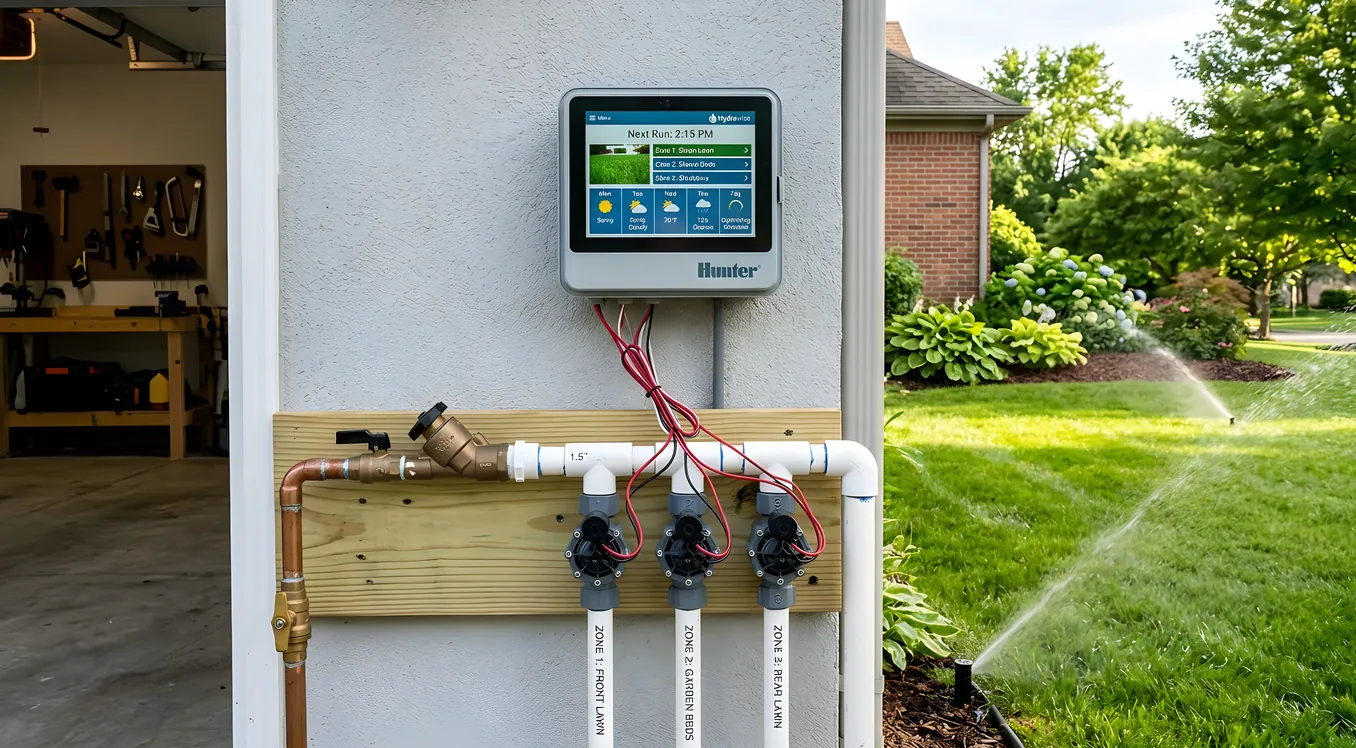
A lawn sprinkler running during a rainstorm is one of those things that seems almost comically wasteful once you notice it. The reality is that most conventional irrigation timers don’t know whether it rained last night, whether soil is already saturated, or whether a heat wave is forecast for tomorrow. They run on a schedule, and that’s it. Smart irrigation systems solve this by replacing the schedule with real-world data: local weather, evapotranspiration rates, soil moisture readings, and plant type. The result isn’t just lower water bills. It’s a landscape that actually responds to conditions rather than ignoring them.
This article covers how weather-based irrigation systems work, what the hardware looks like at different price points, how zone valve control functions, and where smart irrigation fits into a broader home automation setup. If you’re evaluating products or trying to understand what a professional installation actually involves, this is the context you need before spending money.
What Makes an Irrigation System “Smart”
The term gets applied loosely, but there are meaningful differences between a timer with a rain sensor and a genuinely intelligent watering system. Understanding those differences helps you evaluate what’s worth buying.
A basic conventional timer runs on a fixed schedule: zone 1 waters Monday, Wednesday, Friday from 6 AM to 6:15 AM. Add a rain sensor, and the system skips watering if it detects precipitation. That’s useful but primitive. The sensor doesn’t know how much it rained, whether the soil absorbed it, or whether conditions three days from now justify watering today.
A weather-based smart irrigation controller does something more sophisticated. It pulls local weather data (temperature, humidity, wind speed, solar radiation) and calculates evapotranspiration (ET), which is the rate at which water leaves the soil through both plant transpiration and direct evaporation. The controller compares ET to any measured precipitation, estimates soil moisture levels, and determines how much supplemental watering each zone actually needs. If significant rain is forecast, it may skip today’s watering entirely. If a heat wave drove high ET yesterday, it may run longer than the schedule suggests.
The better systems also account for plant type, soil composition, slope, and sun exposure per zone. A shaded grass zone in clay soil behaves very differently from a sloped, south-facing zone planted with drought-tolerant shrubs. Smart controllers let you configure these parameters so the ET-based calculations are accurate rather than generic.
The Leading Smart Irrigation Controllers
The market has consolidated around a handful of controllers that handle weather-based scheduling well. Here’s how the main products compare at the feature level.
Rachio 3 remains the most widely installed consumer smart irrigation controller. It’s available in 8-zone ($229), 12-zone ($279), and 16-zone ($329) versions. The Rachio 3 uses what the company calls Flex Daily scheduling, which models soil moisture mathematically and runs zones only when the modeled moisture drops below a threshold. It pulls weather data from a network of local weather stations and integrates with Amazon Alexa, Google Home, and Apple HomeKit. Installation is DIY-friendly: the Rachio 3 replaces your existing timer at the same location, connects to your Wi-Fi, and runs on your existing zone wiring. Most installs take under an hour. The app is well-designed, and Rachio’s weather intelligence is genuinely effective at reducing runtime compared to fixed schedules. Many homeowners report 30 to 50 percent reductions in outdoor water use after switching.
RainBird ST8I-WiFi and ST8I-2.4GHz controllers represent a more contractor-oriented approach. RainBird has been the dominant professional irrigation brand for decades, and their smart controllers are designed to fit into existing RainBird system infrastructure. The ST8I-WiFi runs about $180 to $220 and supports up to 8 zones, with expansion to 16 using an add-on module. The weather-adjustment capability is called Rain Bird’s “CLIMATE LOGIC,” and it works similarly to ET-based scheduling. RainBird products are more commonly found in professionally installed systems.
Hunter Hydrawise is the professional integrator’s choice for larger residential and light commercial applications. The Hydrawise HC 1200i supports 12 zones at around $180, with the HC 600i at 6 zones for approximately $130. Hydrawise distinguishes itself with its cloud-based predictive watering algorithm, which forecasts weather up to 14 days out and pre-adjusts schedules. The Hydrawise platform also offers contractor features: remote access to multiple client accounts, flow sensor integration for leak detection, and detailed runtime reports. If a professional is installing your irrigation system and you want them to be able to monitor it remotely, Hydrawise is the platform they’re most likely to use.
Orbit B-hyve XD offers strong value at a lower price point. The 12-zone version runs around $130, and the 6-zone is about $80. Orbit’s weather sensing uses a similar ET-based approach, and the B-hyve app handles scheduling well for most residential landscapes. Build quality is a step below Rachio, but for straightforward installations with standard grass zones, it performs reliably.
Zone Valve Control: What’s Actually Happening Underground
The controller is the brain, but the zone valves are what actually deliver water. Each irrigation zone has its own solenoid valve, typically located in a valve box buried at or near grade. The controller sends a 24VAC signal to each valve’s solenoid in sequence, opening the valve to pressurize that zone’s pipes and sprinkler heads.
Standard residential valves from brands like RainBird, Hunter, and Toro run from about $15 to $40 per valve. These are reliable, proven components that last 10 to 20 years with normal maintenance. When an existing irrigation system is converted to smart control, the valves themselves usually don’t need to be replaced. The smart controller simply replaces the timer while the valve wiring stays the same.
For new installations or systems with failing valves, there are smart valve options that add monitoring capability. Hunter PGV valves with flow sensors can detect if a zone is running at higher than expected flow (indicating a broken head or line) or lower than expected flow (indicating a clogged head or closed shutoff). When paired with a flow-capable controller like the Hydrawise, these discrepancies trigger alerts and can automatically shut down the affected zone to prevent water waste or property damage.
Wireless valve controllers are worth mentioning for specific situations. Orbit B-hyve Smart Hose Faucet Timer ($60 to $80) and similar products from Rain Bird and Hunter attach directly to an outdoor hose bib and allow timer or app-based control without any low-voltage wiring. These work well for drip irrigation systems feeding container gardens, raised beds, or planting areas away from the main system. They integrate with the same apps as the full controllers and respond to the same weather-based adjustments.
Moisture Sensors and the Case for Ground Truth
One limitation of purely weather-based ET calculations is that they’re still models. They estimate soil moisture based on weather data and zone parameters. Actual soil conditions can vary based on runoff, drainage, microclimate effects, and other factors the model doesn’t capture.
Soil moisture sensors address this by measuring actual volumetric water content in the ground. The two most common residential options are Rachio Wireless Flow Meter (which detects flow anomalies, around $80) and third-party capacitive soil sensors that plug into controllers supporting wired sensor inputs.
Vegetronix VH400 capacitive sensors (around $30 to $45 each) can be buried in representative zones and wired to a controller’s sensor terminal. They output a voltage corresponding to soil moisture content. Some controllers can read this directly; others require an integration hub. The payoff is accurate, ground-truth data rather than calculated estimates. For landscapes with significant investment (native plantings, fruit trees, established shrub borders), the cost of sensors is easily justified by plant health benefits alone.
How Smart Irrigation Connects to the Rest of Your Home
A standalone Rachio or Hydrawise controller provides real value on its own. But when irrigation integrates with a broader home automation system, the capabilities expand meaningfully.
The most common integration point is with a home automation hub. Rachio, RainBird, and Hunter all offer integrations with SmartThings, Home Assistant, and Amazon Alexa. These allow you to trigger irrigation events based on conditions beyond the irrigation system’s native logic: turning off a zone if a moisture sensor in the yard reads above a threshold, pausing watering when a weather station shows wind above 15 mph (to prevent drift and uneven coverage), or logging runtime data alongside other home energy data.
For professional smart home installations, platforms like Control4, Savant, and Crestron support irrigation control as part of whole-home automation. A Control4 dealer can create a driver that pulls Rachio or Hunter zone status into the main Control4 interface, letting you view and control irrigation from the same touchpanel or app you use for lighting, climate, and security. This makes sense in homes where the priority is a single, unified interface rather than juggling multiple apps. You can see how this kind of integration plays out across other systems in an article on whole-home energy monitoring that covers how tracking outdoor water use fits into a complete consumption picture.
For homeowners with solar installations, irrigation scheduling can be coordinated with solar production data. Running high-draw loads (pumps, pool equipment, irrigation system pump stations) during peak solar generation hours reduces grid draw and in some cases maximizes self-consumption. The solar and smart home integration article covers how this coordination works in more depth.
Weather data is another natural connection point. Controllers like Rachio pull from public weather station networks (Weather Underground’s personal weather station network, NOAA data), but a quality home weather station provides hyperlocal accuracy that regional stations can’t match. Davis Instruments Vantage Vue (around $380) and the Tempest Weather System ($339) both offer APIs that can feed local data directly to irrigation controllers or to a hub that then adjusts schedules. If your property is in a microclimate, like a coastal fog zone where ground-level humidity and temperature diverge significantly from the nearest weather station, a local station pays for itself in scheduling accuracy.
Pump Start, Master Valve, and More Complex Configurations
Standard residential irrigation runs on municipal water supply at normal household pressure. The controller opens valves, water flows, done. But a meaningful percentage of homes, particularly those with large lots, have more complex water delivery systems.
Well-fed irrigation systems require a pump start relay. When the controller activates a zone, it must also signal a relay to start the well pump. Most smart controllers support this: Rachio 3 has a dedicated master valve/pump start terminal (terminal labeled “M”) that can be wired to the relay. Hunter Hydrawise similarly supports pump start configurations. Get this wrong and you’re either running a pump dry or not delivering water at all, so it’s worth confirming your controller explicitly supports your setup before purchasing.
Booster pumps are used in homes where the street pressure is insufficient for the irrigation system’s design. These are more common in rural areas or properties with long pipe runs. The pump start configuration is similar to well pumps.
Master valve setups add an additional solenoid valve at the mainline that stays closed when no zones are running. This prevents slow leaks through zone valves from adding up to significant water loss over time and also serves as a safety shutoff if the controller detects anomalous flow. Many professional installers recommend master valves on systems with flow sensors as a standard practice.
Drip irrigation zones require pressure regulation that overhead spray zones don’t. Most drip zone manifolds include a built-in pressure regulator (typically set to 25 to 30 PSI) and filter. From the controller’s perspective, a drip zone is identical to a spray zone: the controller opens a solenoid valve for a set duration. The difference is in how you configure runtime. Drip emitters deliver water much more slowly than spray heads (often 0.5 to 2 gallons per hour per emitter versus 1 to 3 gallons per minute for a spray head), so ET-based runtime calculations need zone parameters adjusted accordingly. Rachio’s app allows you to designate a zone as drip and configure emitter output rates, which the algorithm uses to calculate appropriate run times.
What a Professional Installation Adds
DIY installation is genuinely straightforward for replacing an existing controller with a Rachio or similar product. You photograph the existing wiring, disconnect the old timer, connect wires to the corresponding terminals on the new controller, and follow the app setup. Most homeowners complete this in under an hour.
Where professional installation earns its cost:
New system design requires proper zone layout, head spacing calculations, precipitation rate matching (getting all heads in a zone to deliver water at similar rates), and pipe sizing. Poor zone design causes dry spots and overwatering simultaneously. A qualified irrigation contractor using industry standards (from the Irrigation Association) will produce a design that the controller can optimize. A smart controller running a poorly designed system still produces poor results.
Flow sensor integration typically requires cutting into the mainline and installing a flow meter, which is plumbing work that most homeowners prefer to hire out. The payoff is leak detection and consumption tracking at the zone level.
Integration with Control4, Savant, or Crestron requires a certified dealer for the automation platform. This isn’t a DIY project, and the irrigation component is typically a small part of a larger integration engagement.
Large or complex systems (more than 16 zones, pump configurations, multiple water sources) benefit from professional programming and commissioning to ensure all the zone parameters are correctly configured.
A basic professional controller installation (replacing a residential controller and configuring zones) typically runs $200 to $500 in labor. A new system installation on a typical suburban property (4,000 to 8,000 square feet of irrigated area) ranges from $2,500 to $6,000 installed, depending on zone count, head type, and access complexity.
Expected Water Savings: What the Research Shows
Water savings from smart irrigation are real and meaningful, but they vary significantly based on baseline efficiency. Switching from a fixed-schedule timer to a well-configured weather-based controller typically produces 20 to 50 percent reduction in outdoor water use. The EPA’s WaterSense program, which certifies irrigation controllers, cites data suggesting certified controllers save an average of 8,800 gallons per year on a typical home. In drought-prone or water-restricted areas, the financial return on a $250 controller is often under two years at local water rates.
For comparison: a typical suburban home in the western US uses 60 to 70 percent of total household water outdoors during summer months. At $0.008 to $0.012 per gallon (common tiered pricing in California, Arizona, and Nevada), saving 8,000 gallons saves $64 to $96 annually. In markets with higher tiered rates, the math is better. In high-water-cost regions like the San Francisco Bay Area, some tier 3 rates exceed $0.025 per gallon, making the annual savings on a smart controller $200 or more.
Rebates accelerate payback further. Many water utilities offer rebates specifically for WaterSense-certified controllers, typically ranging from $50 to $200. Rachio publishes a rebate lookup tool on their website where you can check your local utility’s offer before purchasing.
Managing Irrigation Alongside Other Climate Systems
One pattern worth noting for homeowners building out smart home systems more broadly: irrigation scheduling fits naturally alongside other climate management decisions. The same hub that controls a zoned HVAC system can trigger irrigation holds when the house is in vacation mode, coordinate outdoor watering with pool equipment runtime, or log outdoor water use as part of a complete property consumption picture.
Smart irrigation also has a relationship with landscape health that connects to indoor air quality indirectly. Properly irrigated landscapes (especially those with established trees and shrubs) reduce soil erosion, dust, and particulate matter around the home, which matters if you’re also thinking about filtration and indoor air quality through something like a smart HVAC filter system.
Getting the Most from Your System
A few things that separate effective implementations from frustrating ones:
Configure zone parameters carefully. The biggest single improvement you can make over default settings is accurate soil type, plant type, slope, and sun exposure data for each zone. These parameters directly affect ET calculations and watering decisions. Spend 20 minutes getting them right when setting up the controller.
Use a local weather station if you’re in a microclimate. Rachio allows you to designate a personal weather station from the Weather Underground network as your source. If there’s a station within a mile of your property with good data quality, use it instead of the regional station.
Enable flow monitoring if your controller supports it. Leak detection pays for itself the first time it catches a cracked head or valve that would otherwise run undetected for a billing cycle.
Check zone runtime reports after the first full season. Smart controllers log actual runtime versus scheduled runtime. If Flex Daily is cutting runtime dramatically in some zones and running others for longer than expected, review those zone parameters for accuracy.
Making the Decision
A smart irrigation system makes sense for almost any home with an in-ground system. The payback period is short, installation is usually straightforward, and the reduction in hands-on management is real. If you’re replacing an aging conventional timer anyway, there’s no good reason to buy another conventional timer when Rachio 3 starts at $229.
For homeowners with new construction, complex systems, or a preference for unified control through a professional platform like Control4 or Crestron, working with an irrigation contractor and home automation integrator together produces the best outcome. The additional cost is real, but so is the difference between a system that works transparently and one that requires ongoing manual intervention.
The underlying promise of weather-based watering is simple: your irrigation system should respond to the world as it actually is, not as you scheduled it to be three months ago. That’s not a complicated ask, and the technology to deliver it is affordable and mature.