Circadian Lighting: How Smart Homes Sync Light to Your Body
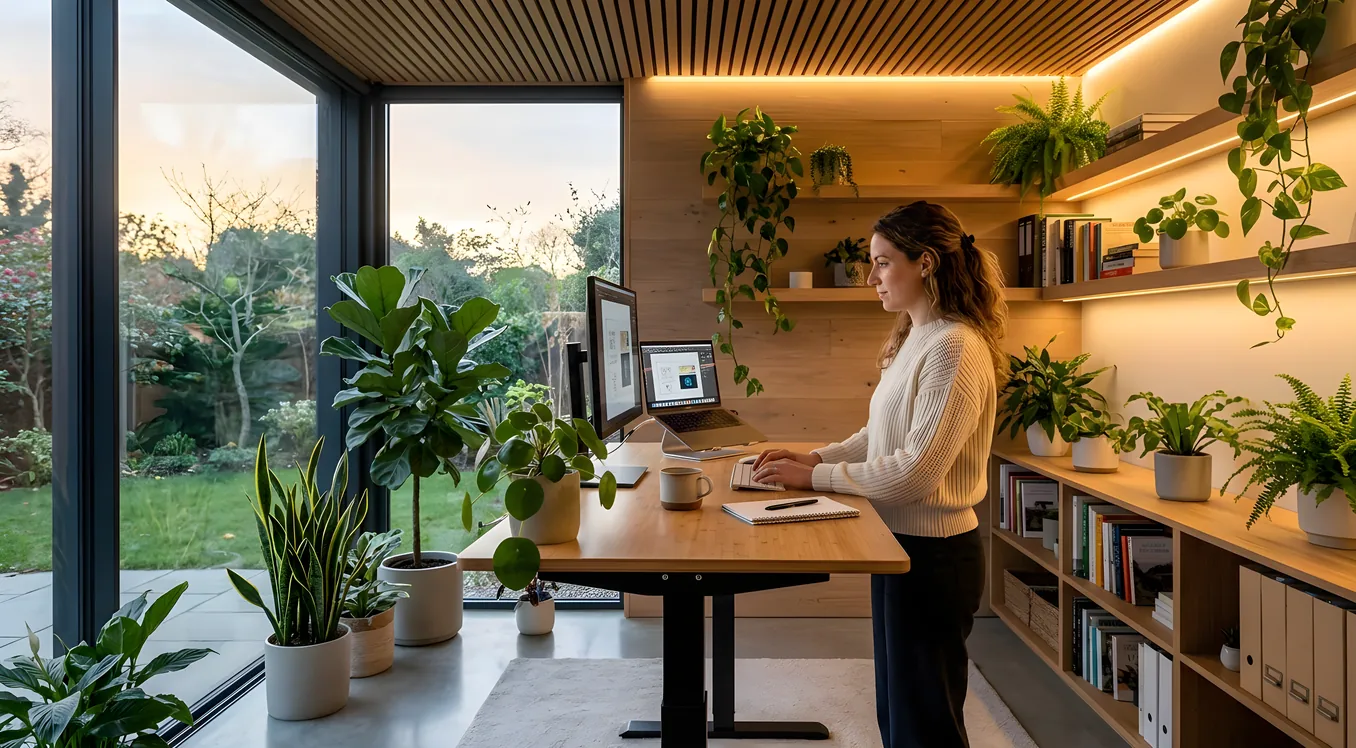
Your body runs on a 24-hour biological clock that has been calibrated to sunlight for millions of years. Morning light with high blue content tells your brain to suppress melatonin, raise cortisol, and sharpen focus. Afternoon light gradually shifts warmer. Evening light, if it stays amber and dim, signals the brain to prepare for sleep. The problem is that modern homes do the opposite: overhead LED fixtures blast cool, bright white light at 9 PM, and blackout curtains keep morning sun from doing its job. Circadian lighting systems exist to fix that mismatch.
The core idea is straightforward. Instead of lights that stay at a fixed color temperature and brightness all day, circadian systems automatically shift the quality of light throughout the day to mirror what the sun does outdoors. Mornings start with cooler, brighter light. Afternoons hold neutral mid-range tones. Evenings fade toward warm amber. The system does this on its own, based on your local sunrise and sunset times, without you adjusting a single slider.
What makes this relevant to smart home buyers right now is that the hardware and software to do this properly has become genuinely practical. Five years ago, tunable lighting required six-figure budgets and custom integration work. Today, you can implement meaningful circadian control at a range of price points, from a few hundred dollars for a single room to a whole-home system that rivals medical-grade light therapy installations.
Why the Color of Light Matters More Than Brightness Alone
Most homeowners understand that dimming lights in the evening is relaxing. What many miss is that dimming alone doesn’t solve the problem. The color temperature of light, measured in Kelvin (K), has a significant and independent effect on your biology.
Light in the 5000K to 6500K range (cool, blue-white, like midday sky) suppresses melatonin most aggressively. That’s useful at 7 AM when you need to wake up. It’s counterproductive at 8 PM when you’re trying to wind down. Light in the 2200K to 2700K range (warm, amber, like candlelight or incandescent bulbs) has minimal effect on melatonin suppression. Dim and warm together is what your nervous system is looking for when sleep is approaching.
The research on this is substantial. Studies on melanopsin-containing retinal ganglion cells have clarified exactly which wavelengths drive circadian disruption, and 480nm blue light is the primary culprit. Standard “warm white” LED bulbs sold at hardware stores typically still emit enough blue light to cause measurable melatonin suppression. True circadian lighting requires fixtures that can actively remove blue wavelengths in the evening, not just shift toward warmer tones on a dial.
This distinction matters when evaluating products. A smart bulb that offers “warm” scenes but still reads 2700K at 10 PM is better than nothing, but it’s not the same as a system that drops to 1800K with minimal blue content. The difference shows up in how quickly people fall asleep and how rested they feel.
The Hardware Behind Circadian Control
Circadian lighting systems break down into two categories based on how they achieve color temperature control: tunable white fixtures and full-spectrum (RGB+W) fixtures.
Tunable white systems use two channels of LEDs: one cool white (typically 4000K to 6500K) and one warm white (typically 2000K to 2700K). By varying the ratio between these channels, the fixture can produce any color temperature in that range. This is the dominant approach in residential smart lighting because it’s cost-effective and because tunable white LED technology has matured significantly.
Full-spectrum or RGBW systems add red, green, and blue channels to the warm and cool white channels. This allows precise control over the spectral content of light, not just the color temperature approximation. The most capable systems in this category can target specific wavelengths and produce light that more closely matches natural daylight at any time of day.
Ketra, now owned by Lutron, pioneered full-spectrum tunable lighting in the residential market. Ketra fixtures use a five-channel LED system (red, green, blue, warm white, and a dedicated “Natural” white channel) that allows the system to maintain consistent color rendering even as intensity and color temperature change. For homeowners who want the most accurate biological lighting available in a residential package, Ketra is the benchmark. You can read more about Ketra tunable lighting and how it integrates with whole-home systems.
At the more accessible end, companies like Philips Hue (with their White Ambiance and White and Color Ambiance bulbs), LIFX, and Nanoleaf offer tunable white and color capability in standard A19, BR30, and other consumer bulb formats. The Philips Hue White Ambiance line, for example, spans 2200K to 6500K and can be automated through the Hue app to follow a circadian schedule. A Hue BR30 bulb runs about $25 to $35, and a starter kit with a bridge and four bulbs costs around $130 to $180. These are real circadian-capable products, not marketing language.
Professional-Grade Circadian Systems: What You Get at Different Price Tiers
The gap between a $200 Philips Hue setup and a $50,000 Lutron system is real, and it’s worth understanding what you’re actually buying at each level.
Entry-level ($200 to $2,000): Smart bulbs with scheduling
This covers Philips Hue, LIFX, and similar ecosystems. These systems are app-controlled, require a hub (Hue uses a Zigbee bridge, LIFX uses Wi-Fi directly), and can automate color temperature shifts throughout the day. The limitations are meaningful: you’re replacing bulbs rather than fixtures, which means lamp shades and light diffusion affect quality. Not every fixture type is available in tunable white formats. And the scheduling, while functional, tends to be relatively basic.
For renters, apartment dwellers, or homeowners who want to experiment with circadian lighting in a bedroom before committing to a larger project, this tier makes complete sense.
Mid-range ($2,000 to $15,000): Tunable white in-ceiling fixtures with smart switching
This is where permanent installation begins. Products from companies like Lutron Ketra’s entry points, Acuity Brands’ Sensor Switch line, and WAC Lighting’s tunable white architectural fixtures pair with smart dimming systems (like Lutron Caseta or RadioRA 3) to create a more integrated solution.
At this level, you’re working with in-ceiling LED panels, downlights, and linear fixtures that mount permanently. The light quality is substantially better than bulb-based systems because the fixtures are designed around the LED modules rather than retrofitting standard sockets. A typical setup might cover a master bedroom, bathroom, and home office, with scheduling tied to a Lutron hub or integrated into a broader smart home platform.
High-end ($15,000 to $60,000+): Full whole-home circadian integration
This is the domain of Lutron Ketra, Lutron HomeWorks QSX, and bespoke integration projects. At this level, every fixture in the home is tunable. Circadian schedules are programmed into the lighting control system rather than living in an app. The system knows your local latitude and longitude, calculates sunrise and sunset dynamically, and adjusts every zone accordingly.
Lutron’s Ketra system deserves specific attention here. A Ketra N38 retrofit downlight (which fits 4-inch and 5-inch/6-inch cans) runs approximately $200 to $350 per fixture. For a home with 60 fixtures, that’s $12,000 to $21,000 in fixture costs before labor, programming, and any associated Lutron hardware. The full HomeWorks QSX processor for a large home adds another $8,000 to $15,000. These numbers explain why full circadian integration is typically part of new construction or major renovation projects.
What you get for that investment: Ketra’s Natural Light Intelligence (NLI) algorithm continuously adjusts brightness and color temperature to maintain consistent visual adaptation, even accounting for changes in the mix of zones that are active. The system doesn’t just follow a time-based schedule; it maintains biological light quality dynamically.
Integration with Smart Home Platforms
Circadian lighting works best when it integrates with the rest of your smart home, and the platform you’re running shapes what’s possible.
Control4 and Savant both integrate with Ketra and Lutron natively. A Control4 dealer can tie Ketra scenes to other automation events: when the morning routine fires (coffee maker starts, thermostat adjusts, shades open), the lighting simultaneously shifts to morning mode. When you set the “movie” scene, lights in the media room dim to a warm bias to protect night vision.
Crestron offers its own circadian lighting module within the Crestron Home and Crestron Fusion platforms. Crestron’s solution calculates sunrise and sunset based on geographic location and adjusts programmed zones on a continuous curve rather than step changes. Crestron integrators can program custom biological presets tied to occupancy, time, and user preferences.
Apple HomeKit supports color temperature control through its Adaptive Lighting feature, introduced in iOS 14. If you have HomeKit-compatible tunable white bulbs (Philips Hue White Ambiance, Eve Light Strip, and others carry the certification), HomeKit can manage the color temperature shift automatically throughout the day. This is genuinely useful and requires no subscription, though the scheduling algorithm is less configurable than what dedicated systems offer.
Amazon Alexa and Google Home offer circadian-style routines but rely on third-party integrations and lack the continuous adjustment curves that hardware-native systems provide. For basic automation (warm light after sunset, cool light in the morning), they’re functional. For proper biological lighting, the control is too coarse.
Motorized shades are a natural pairing with circadian lighting. If you’re managing light quality inside the home, you should also manage natural light coming in. Motorized shades from brands like Lutron, Hunter Douglas, and Somfy let you automate shade position throughout the day, blocking midday glare while still admitting the morning light that anchors your circadian rhythm.
Planning a Circadian Lighting Project: What to Think Through First
Before calling an integrator or ordering bulbs, a few questions will save you significant frustration.
What fixtures do you have, and can they accept tunable sources?
Recessed downlights in 4-inch, 5-inch, and 6-inch formats have the most retrofit options available. Linear pendant lights, wall sconces, and decorative fixtures are more restrictive. If your home has a lot of decorative fixtures, you’ll be working with smart bulbs or replacing the fixtures entirely.
Where does circadian control matter most?
Most people benefit most from circadian lighting in the bedroom, home office, and kitchen. The bedroom is where sleep initiation happens. The home office is where daytime alertness matters. The kitchen is where most households spend morning and evening time in lighting that directly affects sleep timing. You don’t necessarily need to tune every room in the house; starting with these three spaces delivers the majority of the benefit.
Are you building new, renovating, or retrofitting?
New construction is the cleanest path to full circadian integration. Every fixture choice can be made with tunable capability in mind, and wiring can accommodate the low-voltage control systems that professional lighting uses. Renovations offer partial flexibility. Retrofits are the most constrained; you’re working within existing fixture types, wiring, and often switch locations that may not accommodate in-wall dimmers for tunable fixtures.
Who will program and maintain it?
Smart bulb systems (Hue, LIFX) are self-managed through consumer apps. Professional systems (Ketra, Lutron, Control4) require a certified integrator for initial programming and any significant changes. This isn’t a criticism of professional systems; the programming complexity is what delivers the sophisticated behavior. But it means you’re entering a service relationship, not just buying hardware.
The Decision Between Smart Switches and Smart Bulbs for Circadian Use
This question comes up early in almost every circadian lighting conversation. The answer depends on what you’re trying to achieve and what your existing fixtures look like.
Smart switches paired with dimmable standard bulbs can handle brightness scheduling but cannot shift color temperature unless the bulb itself is tunable. A Lutron Caseta dimmer controlling a standard warm white LED bulb will dim for you on a schedule, but it will always be the same color temperature. For circadian color shifting, you need either smart bulbs in their own right (Hue, LIFX) or in-fixture tunable LEDs controlled by a specialized driver.
Smart bulbs in consumer formats (A19, BR30, PAR) work well when the fixture design is compatible and the installation involves relatively few units. For 6 to 12 bulbs across a bedroom and office, the Philips Hue or LIFX approach is practical and cost-effective. Above that count, or in situations where you want consistent performance across 30, 40, or 60+ fixtures, in-ceiling architectural tunable fixtures with professional controls perform more reliably and look substantially better.
What Circadian Lighting Actually Feels Like to Live With
It’s worth grounding this in what the day-to-day experience is like, rather than spec sheets.
In a well-implemented circadian home, you stop noticing the lighting changes because they happen gradually and feel natural. At 7 AM, the kitchen and bathroom shift to a cool, bright mode that feels like a clear morning. By 2 PM, the light in the home office has dropped slightly in color temperature to match the quality of afternoon sun coming through windows. By 7 PM, rooms shift toward warmer tones. By 9 PM, a low amber bias is standard across the home.
What people report most consistently after living with circadian lighting is falling asleep faster and waking more easily. The system reinforces the body’s natural rhythm rather than fighting it. The second most common observation is that the home feels more comfortable to be in, without being able to articulate why. Biologically, this makes sense: your visual system is receiving information consistent with natural light cycles rather than arbitrary electrical illumination.
The third effect, often underestimated, is that the quality of color rendering throughout the home improves. Tunable white LEDs, especially in Ketra-class systems that maintain high CRI (Color Rendering Index, typically 90+ in quality fixtures), make paint colors, fabrics, and food look more accurate and appealing across the full range of light levels. This isn’t just a comfort issue; it’s aesthetically meaningful in ways that are immediately visible when you see it in person.
Making the Right Call for Your Home
A few honest assessments to help you decide how far to take this.
If you’re primarily motivated by sleep quality and work-from-home focus, start with the bedroom and home office using Philips Hue White Ambiance or LIFX fixtures. Set up a schedule through the native app. The cost is manageable (under $500 for both rooms), and you’ll quickly understand whether the behavioral effects are meaningful for you before committing to infrastructure changes.
If you’re planning a renovation or new build, include tunable capability in your fixture specifications from the start. It costs roughly 20% to 40% more than standard LED fixtures at the architectural level, but retrofitting later costs three to four times as much when you factor in labor, new fixtures, and integration programming.
If you’re building a full smart home with professional integration, circadian lighting should be a foundational part of the lighting control conversation, not an add-on. A Lutron HomeWorks QSX or Crestron-based system supports native circadian scheduling. If you’re already specifying that category of system, adding Ketra fixtures is the natural extension. The result is a home that doesn’t just automate tasks but actively supports the people living in it.
Finding the Right Integrator
Circadian lighting, especially at the Ketra and HomeWorks level, requires a dealer with specific training and experience. Lutron certifies installers for both Ketra and HomeWorks. Ask any prospective integrator how many Ketra projects they’ve installed, whether they have references from completed circadian projects (not just tunable white installations generally), and what the programming process looks like for biological light scheduling specifically.
The better integrators in this space will ask questions about your schedule, your sleep goals, your specific rooms, and how you currently use your home before making any product recommendations. The conversation should start with your life, not a product catalog.
Lighting is one of the few smart home investments with a direct, measurable effect on health and daily function. The science behind circadian lighting isn’t speculative; it’s the basis for architectural standards in hospitals, schools, and office buildings. Bringing those principles home has become practical, and the range of options available today means there’s an entry point for nearly every budget and project type.
For a full overview of smart lighting products, systems, and integration approaches, the Lighting section covers the full range from entry-level switches to professional whole-home systems.