Luxury Smart Home: $75,000+ Full-Integration Systems
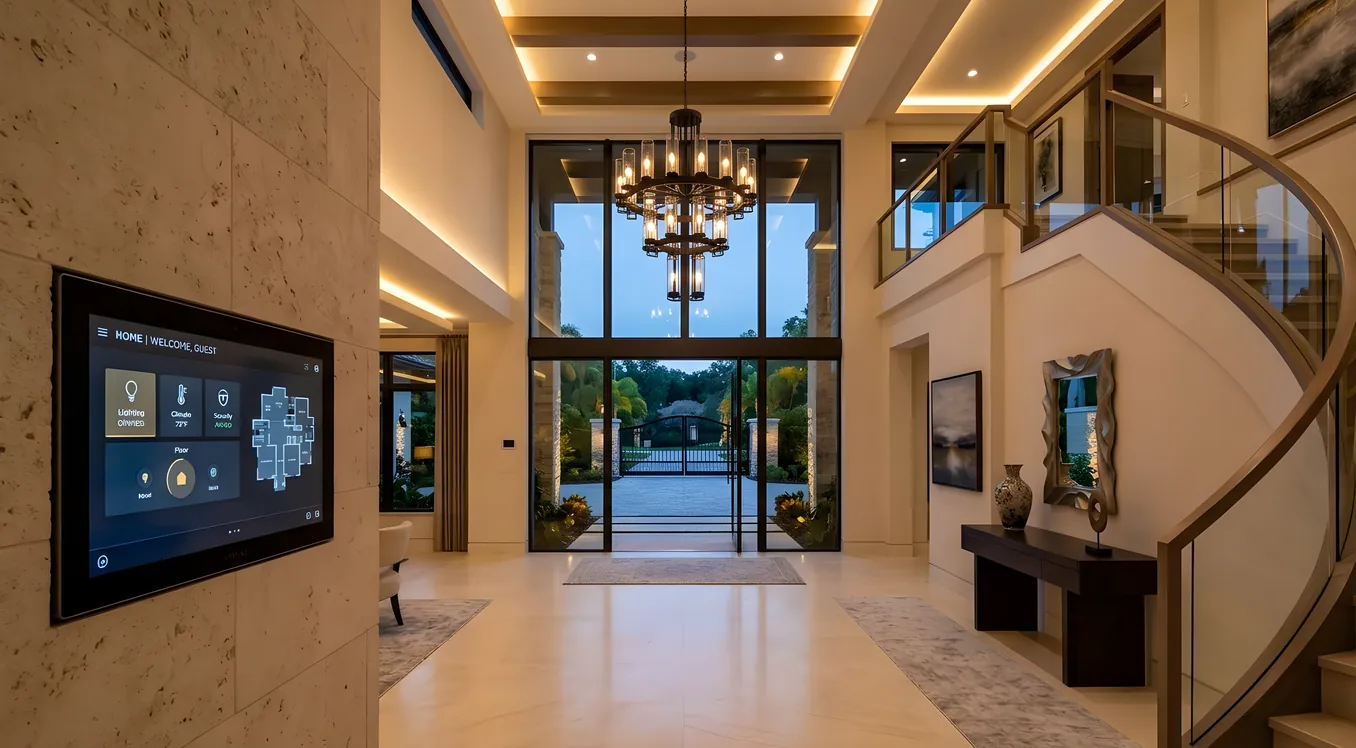
Luxury Smart Home: $75,000+ Full-Integration Systems
There is a significant difference between a smart home and a fully integrated smart home. Most homeowners discover this after spending $10,000 on devices that mostly work independently of each other. A true luxury smart home system is something else: every subsystem in the house speaks a common language, controlled through a single interface, and engineered so that a single button press triggers a choreographed sequence of events across lighting, climate, audio, video, shading, and security.
That level of integration carries a price. Projects in the $75,000 to $250,000 range are common in high-end residential construction. Estate-level systems with full architectural lighting, distributed audio in 20-plus zones, home theater, whole-property security, and advanced networking routinely exceed $500,000. This guide explains what drives those numbers, which platforms professionals actually use at this tier, and what separates a system worth the investment from one that will be a source of frustration for years.
Why Full Integration Costs What It Does
The sticker shock of a luxury smart home system usually comes from underestimating three things: the hardware required at this tier, the labor to program it properly, and the infrastructure it all runs on.
Hardware at the high end is not the same category of product as what you find at a big-box electronics retailer. Lutron Homeworks QSX dimmers run $150 to $350 per device, compared to $30 for a consumer Caseta dimmer. A Crestron DM NVX 4K video distribution matrix capable of routing four sources to twelve displays costs $8,000 to $14,000. A Control4 EA-5 controller (the platform’s flagship residential processor) retails around $1,500 to $2,000, and that is before you count the Triad Audio amplifiers, touchscreens, and distributed speaker infrastructure layered on top.
Programming and commissioning is the line item that surprises most clients. A Control4 or Crestron programmer typically bills $100 to $200 per hour. A full-scale luxury installation involves 80 to 200 hours of programming work before the client ever touches the interface. That is $8,000 to $40,000 in labor for programming alone, on top of installation and low-voltage rough-in work.
Infrastructure is the foundation everything runs on. High-end systems require enterprise-grade structured cabling, a purpose-built equipment rack (often a dedicated mechanical room), and managed networking gear. A properly installed Cat6A infrastructure for a 6,000-square-foot home can cost $15,000 to $30,000 in materials and labor. If you are building new, see Smart Home Pre-Wire: What to Run Before the Drywall Goes Up for a complete breakdown of what needs to go in before drywall.
The full picture of where costs fall in a luxury project is covered in detail in the Smart Home Cost Breakdown: What Systems Actually Cost in 2026, but a rough allocation for a $150,000 project typically looks like this:
- Structured cabling and infrastructure: 15 to 20 percent
- Lighting control hardware and installation: 20 to 25 percent
- Audio/video distribution and home theater: 20 to 30 percent
- Automation platform hardware and programming: 15 to 20 percent
- Security, networking, climate, shading: 10 to 20 percent
The Platforms That Professionals Use
At the $75,000 and above tier, there are three platforms that dominate professionally installed systems: Control4, Savant, and Crestron. Josh.ai sits alongside them as a voice control layer. Each has a different design philosophy and a different client profile.
Control4
Control4 is the most widely deployed platform in the professional residential market. The EA-5 controller handles up to 200 connected devices natively, and the platform’s driver ecosystem supports over 14,000 third-party integrations. Lighting, HVAC, AV sources, security panels, pool equipment, gate systems, and motorized shading can all be brought into a single programming environment.
For a 5,000 to 8,000 square-foot home, a comprehensive Control4 installation covering lighting, distributed audio, home theater, climate, and security typically runs $50,000 to $120,000. That range covers the hardware, low-voltage labor, and programming. The upper end of that range includes a custom home theater room.
Control4 OS 3 brought a significantly improved user interface, with personalized home screens, a universal remote experience, and the Control4 app that gives clients full control from an iPhone or Android device. The programming environment (Composer Pro) gives dealers granular control over every automation sequence, which is why dealer quality matters so much. The same hardware programmed by an average dealer and an exceptional dealer will produce a noticeably different experience.
Savant
Savant targets the luxury tier more deliberately than Control4. The Savant Pro App (available on Apple TV 4K with a Savant interface, as well as iOS and Android) is generally considered the most visually refined interface in the residential automation space. Savant’s background as an Apple-centric platform shows in the design language.
The Savant host controller, the PRO X2-B, retails around $3,500. Savant’s REM (Remote Experience Manager) modules handle individual room control. The platform integrates cleanly with Lutron, Crestron Lighting, and most major AV brands. Savant’s energy management features are more developed than Control4’s for clients interested in tracking consumption across circuits.
Savant projects run slightly higher than comparable Control4 installs, partly because Savant dealers tend toward the ultra-high-end residential market and price accordingly. A comparable 5,000 to 8,000 square-foot project on Savant often lands $20,000 to $40,000 higher than an equivalent Control4 scope. For clients who prioritize interface elegance and are working with architects and interior designers who care about every touchpoint, that premium often makes sense.
Crestron
Crestron is the platform of choice when the scope extends beyond residential into commercial-grade complexity. Estate properties with dedicated server rooms, large conference or media rooms, sophisticated climate control systems, or complex AV distribution to 15 or more zones often gravitate toward Crestron because the programming environment handles that complexity better than the other platforms.
Crestron’s hardware is built to commercial specifications. The MPC3 Multi-Purpose Controller, DMPS3 presentation systems, and DigitalMedia distribution gear are designed for environments where uptime is non-negotiable. Crestron programmers are often the most highly specialized (and most expensive) of the three platforms. Billable rates of $150 to $250 per hour are common, and estate Crestron projects frequently involve 150 to 300 hours of programming.
A mid-range Crestron project for a 6,000-square-foot home runs $80,000 to $180,000 installed. Large estate systems routinely exceed $300,000. Crestron is not a platform you choose because it is elegant out of the box. You choose it because your requirements exceed what other platforms can reliably handle.
Josh.ai
Josh.ai is worth understanding as a voice control layer that sits alongside any of the three platforms above rather than replacing them. Unlike Amazon Alexa or Google Assistant, Josh.ai processes voice commands locally (no audio leaves the house), supports natural language requests with contextual understanding, and integrates deeply with Control4, Savant, and Crestron environments.
A Josh.ai whole-home deployment using Josh Micro devices (small, discreet microphones designed to blend with interior finishes) typically costs $3,000 to $8,000 for hardware, plus integration programming. For clients who want voice control without compromising privacy or dealing with Alexa’s occasional misinterpretations in a complex AV environment, Josh.ai is the professional-grade answer.
Lighting Control: The Backbone of Every Luxury System
Lighting control is where most luxury clients feel the difference most immediately. Flip a switch and the right lights come on at the right level. Walk into a room and the lighting adjusts based on time of day and occupancy. Hit “Good Night” from a bedside keypad and every light in the house turns off, the doors lock, the thermostat steps back, and the security system arms.
At this tier, Lutron is the near-universal recommendation for lighting control. Lutron Homeworks QSX is the flagship residential system. It supports load control for up to 100 zones from a single processor, integrates with virtually every automation platform, and uses Lutron’s Clear Connect RF protocol, which is significantly more reliable than Z-Wave or Zigbee in dense home environments. A Homeworks QSX installation for a 5,000-square-foot home with 60 to 80 controlled loads typically costs $15,000 to $30,000 for hardware and installation.
For clients who want tunable white or full-color lighting, Ketra (a Lutron company) produces the highest-quality architectural tunable LED fixtures available. A Ketra system can shift color temperature from warm amber (1400K) to cool daylight (6500K) automatically throughout the day to support circadian health. Ketra fixtures run $200 to $600 per fixture, and a whole-home deployment adds $15,000 to $50,000 to a project depending on scope.
Motorized shading integrates with lighting control to form a complete daylight management system. Lutron’s Palladiom shades (their top residential line) work natively with Homeworks QSX so that shades and lights can be choreographed together. Hunter Douglas PowerView Gen 3 is the alternative for clients who prioritize fabric selection over integration depth. Whole-home motorized shading for a 5,000-square-foot home typically runs $20,000 to $60,000 depending on window count, shade type, and fabric selections.
Distributed Audio and Whole-Home Video
A serious distributed audio system is one of the most tangible day-to-day benefits of a luxury smart home. Music follows you through the house. The right playlist starts automatically when you arrive. A guest suite can have its own audio zone independent of the rest of the house.
At the professional tier, Sonos is a common solution for whole-home audio in projects where budget or aesthetic simplicity takes priority. Sonos Amp ($699 each) drives passive in-ceiling speakers and integrates with Control4 and Savant. A 10-zone Sonos system with Sonance or Polk Audio in-ceiling speakers runs $8,000 to $20,000 installed.
For higher-end audio performance, Triad Audio (owned by SnapAV, the same parent as Control4) produces amplifiers and speakers designed for rack-mount integration. A Triad AMS-44 amplifier handles four amplified zones and retails around $1,200. Paired with premium in-ceiling speakers from brands like James Loudspeaker or Origin Acoustics, a 10-zone system can run $20,000 to $45,000 installed. Clients who want audiophile-grade performance in a distributed system sometimes specify Lyngdorf or McIntosh amplification for their main listening zones.
Whole-home video distribution, where you can send any source to any display in the house, requires a video matrix or IP-based distribution system. Crestron DM NVX and Atlona are the leading platforms for AV-over-IP at this tier. A system routing four to six sources (Apple TV, cable, Blu-ray, game console) to eight to twelve displays costs $12,000 to $25,000 for the distribution hardware alone.
Security and Networking at This Level
A luxury home’s security infrastructure goes well beyond a consumer Ring setup. Professional-grade security at this tier typically involves a dedicated panel, cameras on a dedicated network segment, and integration with the automation platform so that security events can trigger lighting scenes, unlock doors, or surface camera feeds on touchscreens.
Alarm.com is the most common professional security platform for residential integrations. Its API allows full Control4 and Savant integration. DSC PowerSeries Pro and Qolsys IQ Pro are common panel choices. A whole-home security deployment with a monitored panel, 12 to 20 cameras, motion sensors, door/window contacts, and smart locks typically runs $8,000 to $25,000 installed.
For cameras, Luma Surveillance (SnapAV brand) and Axis are the standard professional recommendations. A Luma 4K IP camera runs $200 to $400, and the footage stores to a dedicated NVR. Ring doorbell cameras can integrate into the system, but professional installers generally avoid them as the primary camera system due to cloud dependency and reliability concerns.
Networking infrastructure for a luxury smart home deserves more investment than most clients expect. Every subsystem, from lighting controllers to AV distribution to IP cameras, runs on the network. An enterprise-grade managed switch, wireless access points capable of handling 50-plus concurrent devices, and a router with proper VLAN segmentation are minimum requirements. Araknis (SnapAV) and Ruckus are the most common professional recommendations. A properly spec’d networking infrastructure for a 5,000 to 8,000 square-foot home runs $5,000 to $15,000 installed.
The Integrator Selection Is the Most Important Decision
Every platform decision, hardware choice, and programming approach depends on the integrator executing it. A well-programmed Control4 system outperforms a poorly programmed Crestron system every time. Choosing the right integration partner is more important than choosing the right platform.
The signals to look for when evaluating integrators: are they a Cedia member? Do they have Control4 Gold or Platinum dealer status, or Savant’s highest certification tier? How many completed projects in your home’s size and complexity range can they show you? Can they connect you with three references who have lived with their systems for at least two years? What happens when something breaks at 9pm on a Friday?
The warning signs are equally important: vague answers about programming hours, no clearly defined project management process, reluctance to provide references, or proposals that jump to specific products before fully understanding your requirements. If you are evaluating integrators for the first time, How to Choose a Smart Home Integrator: Questions, Red Flags, References covers the full vetting process in detail.
What Full Integration Actually Delivers
When a luxury smart home system is designed and programmed well, the technology becomes invisible in the best possible way. The house responds to how you live rather than requiring you to manage it.
Morning mode starts at 6:30am: the primary bedroom shades open slowly, bathroom lights come up to 30 percent at 2700K, the coffee maker starts, and the thermostat steps up from its overnight setback. You walk into the kitchen and the playlist you left last night picks up where it stopped. The garage door opens as your car approaches, and the driveway lights activate.
When you leave, a single tap or geofence trigger turns off every light, locks every door, sets back the thermostats, and arms the security system. When you come back, everything is set the way you prefer before you open the front door.
These sequences are not particularly complex to program, but they require that every system in the house speaks the same language. That is what a full-integration platform provides. That is what the investment buys.
For homeowners who are not certain they need a $75,000 system, it is worth being honest about what you actually use day-to-day. A well-designed $15,000 to $30,000 system handles lighting, climate, audio, and basic security with an excellent interface. See the Budget Smart Home: The Best System Under $5,000 guide for the lower end of the spectrum, or if you are working in an existing home without rewiring options, Retrofitting a Smart Home: What Works Without Rewiring covers what is achievable without major construction.
The luxury tier is the right choice when the scope of the project, the size of the home, or the expectations of the client require a platform built for that level of complexity. Understand what the investment covers before committing, choose an integrator with a track record at your project size, and build on infrastructure that can grow with your needs.
Questions Worth Asking Before You Sign
Before committing to a luxury smart home project, get clear answers to these specific questions from any integrator you are considering:
What controller platform are you recommending, and why is it the right choice for my specific project? If the answer is reflexive rather than tied to your requirements, push back.
How many hours of programming are included in the proposal, and what is your hourly rate for changes after commissioning? Scope creep in programming is the most common budget surprise in high-end projects.
What is your process for ongoing support? Is there a service plan? What does it cover? What is the response time for critical failures?
Can I see the project file for a completed project of similar scope? Not the finished system, but the programming documentation. Professional integrators maintain version-controlled project files. This shows how organized their process is.
Who owns the programming if I need to switch dealers? Control4 and Savant project files are dealer-locked by default. Understanding the exit terms before you start protects you later.
The right answers to these questions, combined with verified references and a proposal that maps hardware to your specific requirements, are what separate a successful luxury smart home project from the ones that end up in disputes.