Residential Access Control: Gate, Garage, and Entry Systems
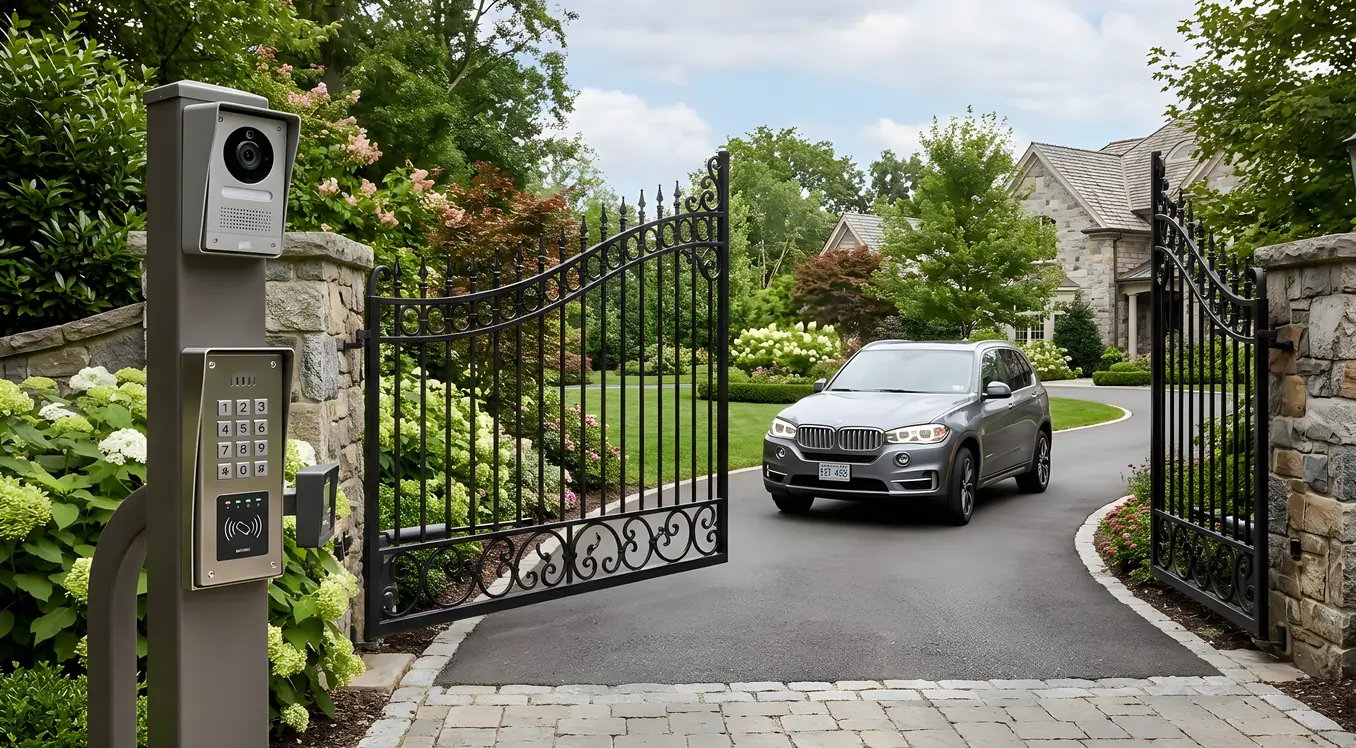
Most homeowners do not think about access control as a system. They think about a front door lock, a garage opener, and maybe a gate if they have a driveway. But once you start connecting these pieces, you realize they are doing the same job from three different directions, and making them talk to each other is where residential access control gets interesting and occasionally frustrating.
This article covers the full picture: standalone hardware at each entry point, the integration options that tie them together, what professional-grade systems actually offer over consumer products, and how to think about costs across a realistic project. Whether you are adding a single smart lock or spec’ing a whole-property access system with a gate, garage, multiple entry points, and video at each, the decisions upstream affect the ones downstream in ways that are worth understanding before you buy anything.
Why Entry Points Deserve Coordinated Thinking
Here is the problem with buying access control products one at a time: each manufacturer builds their app, their hub, and their ecosystem with their own product sales in mind, not your whole-property workflow.
A Ring video doorbell and a Schlage Encode lock and a LiftMaster MyQ garage opener and a FAAC gate operator can all technically be on the same property. They will each have their own app. They will not tell each other anything. When a guest arrives at your gate at 2 PM on a Tuesday, you will open the gate from one app, watch them on a doorbell camera from another, and maybe get a notification from a third that the front door was unlocked. None of this is impossible to use, but it is friction you did not have to buy.
The reason to think about this before you purchase is that the integration path is much easier to build in at the start than to retrofit later. The gate operator you choose, the garage controller, the lock protocol, whether you want Z-Wave or Zigbee or Matter or proprietary RF, all of it affects your options later. This is true even at the consumer level, and it becomes very important if you are working with a professional integrator on a Control4, Savant, or Crestron system.
Gate Systems: What You Are Actually Buying
A residential gate operator is a motor, a control board, a radio receiver, and a mechanism that moves your gate. The complexity and cost depend primarily on gate type (sliding versus swing), gate weight and size, and how many accessories you need at the entry point.
For a single-panel swing gate up to 16 feet wide and 800 pounds, operators from FAAC, LiftMaster, and Linear start around $800 to $1,200 for the operator itself. A dual swing gate with two operators runs $1,500 to $2,500 in hardware. Slide gate operators for heavier aluminum or iron panels can run $1,200 to $3,000 depending on panel weight and travel distance. Installation on top of hardware can add $800 to $2,000 depending on site conditions, conduit runs, and accessory wiring.
The accessories at the gate entry point are where costs accumulate and where the system differentiation happens:
Keypads and intercoms. A basic keypad (Linear AK11, DoorKing 1802, BFT entry keypads) allows PIN-based entry and runs $150 to $350 installed. A video intercom at the gate is a significant step up. 2N Helios intercoms start around $600 for the IP unit plus mounting hardware and installation. Aiphone GT series, popular with integrators, runs $400 to $800 for the outdoor station plus $200 to $400 for the indoor unit. These systems stream video and allow two-way audio from a dedicated indoor panel, from a smartphone app, or through integration with a home automation controller.
Access cards and fobs. Wiegand-based card readers (HID, Farpointe) provide a more commercial feel and support credential management at scale. If you have household staff, regular vendors, or frequent guests, card-based access lets you issue and revoke credentials without managing PIN lists. A basic HID reader plus controller runs $300 to $600 at the low end.
Vehicle loops and safety sensors. Any gate on a driveway with regular vehicle traffic should have safety loops embedded in the concrete (or magnetic sensors for asphalt), plus photo-eye sensors that prevent the gate from closing on a vehicle or person. These are not optional features from a liability standpoint. Budget $400 to $800 for proper safety hardware on a residential install.
The integration decision at the gate matters. LiftMaster operators integrate with myQ Home (the consumer ecosystem) and with Control4 and Crestron through driver-based integrations. FAAC offers IP-connected controllers that work with professional automation platforms. If you plan to have a Control4 or Savant system manage the property, verify before you buy that your gate operator either has a supported driver or exposes a relay contact that the controller can trigger. Almost all operators have dry contact relay inputs; the question is how much automation you can build on top of a simple relay trigger versus a full two-way communication driver.
Garage Door Control: The Underestimated Entry Point
The garage is statistically the most common entry point to a home. A significant percentage of residential break-ins go through the garage, and the garage door opener installed with the house in 1998 may have security technology from the 1990s as well.
Modern garage door operators from Chamberlain, LiftMaster, and Genie include rolling code technology as standard. The LiftMaster 84501 (around $280) includes myQ connectivity, a built-in camera, and LED lighting. The Chamberlain B4545 ($230) includes Wi-Fi, battery backup, and myQ app control. These are solid consumer products with real-world reliability.
The myQ ecosystem deserves specific attention because it has wide compatibility and a complicated integration story. myQ works natively with Google Assistant and Amazon Alexa for voice status queries but not direct voice open commands (a deliberate security decision by Chamberlain). myQ integrates with Ring alarm systems. The third-party API that tools like Home Assistant used for years was shut down by Chamberlain in 2023, which frustrated the DIY automation community significantly. If deep third-party integration is important to you, LiftMaster’s commercial CAPXLV controller offers a more open Ethernet interface that professional integrators use.
For professional integration, the path is cleaner. Liftmaster’s 841LM Internet Gateway or dedicated Ethernet-connected operators expose APIs that Control4, Savant, and Crestron can control directly with supported drivers. A garage door module in a Control4 system means one dashboard shows gate status, garage door status, front door lock status, and all camera feeds in a single interface. The garage becomes part of an arrival/departure scene rather than a separate device you check separately.
Garage door sensors matter beyond the opener itself. A tilt sensor on the door (many come built-in with smart openers) gives you open/closed status. A contact sensor inside the garage on any interior door to the living space is worth adding. These feed into smart alarm systems and allow automations like “if the garage door is open for more than 20 minutes and no car is in the driveway, send a notification.”
Smart Locks for Entry Doors: Protocol and Performance
The market for smart locks has matured considerably. The hardware quality gap between consumer locks like Schlage Encode Plus ($300) and Yale Assure Lock 2 ($200 to $300) versus professional-grade hardware from Allegion (Schlage Commercial) or Kwikset (commercial line) has narrowed at the lock mechanism level. The difference between tiers shows up in:
Protocol and integration. Consumer locks use Wi-Fi, Z-Wave, Zigbee, or the newer Matter standard. Professional integrators typically prefer Z-Wave or Zigbee for reliability, or manufacturer-specific systems for larger projects. Yale makes locks certified for Control4, including the Yale YRD226 and YRD256, which communicate over Z-Wave and integrate with Control4’s security module for credential management across multiple locks. Schlage’s BE469ZP ($250 to $280) is a Z-Wave Plus deadbolt with strong third-party integration support.
Matter, the newer interoperability standard backed by Apple, Google, Amazon, and a consortium of manufacturers, is changing some of this calculus. The Schlage Encode Plus with Apple Home Key ($300) allows NFC-based entry using an iPhone or Apple Watch held near the lock, which eliminates the “fumble for the app” problem for iPhone households. As Matter-certified locks proliferate, the integration overhead between consumer and professional ecosystems should reduce.
Access codes and credential management. A lock with 10 access code slots handles a typical household. A lock with 100 to 250 slots handles household staff, house cleaners, dog walkers, and periodic guests with unique codes. The Yale Assure Lock 2 holds 250 codes. Through a Control4 or Savant integration, code creation and expiration can be automated: a house cleaner’s code works only on Tuesday mornings between 9 AM and 1 PM, then disables automatically without any manual management.
Physical security beyond electronics. ANSI/BHMA Grade 1 deadbolts resist kick-in attacks and drilling better than Grade 2 hardware. The Schlage B60N (a non-smart deadbolt, $40) is a Grade 1 deadbolt; the Schlage Encode Plus smart lock is also Grade 1. Most Yale consumer smart locks are Grade 2. For doors that receive significant security attention, the lock itself should be Grade 1, and the door frame and strike plate reinforcement matter as much as the lock.
Video at the Entry Points
Video doorbell and entry cameras serve two functions: real-time awareness of who is at the door, and recorded evidence when something goes wrong. These are different requirements and sometimes suggest different hardware choices.
For real-time awareness at the front door, a video doorbell integrates the alert and the response. Ring Video Doorbell Pro 2 ($250) and Nest Doorbell (Wired, second gen, $180) are the dominant consumer options. Both offer motion alerts, two-way audio, and package detection. The more complete comparison of these and professional alternatives is in video doorbells compared, but for the access control conversation, the integration matters most: does the doorbell alert connect to the same platform managing your lock and gate, or is it another separate notification stream?
For evidence recording, a fixed camera at each entry point is more reliable than a doorbell camera alone. Doorbell cameras have limited field of view. A separate outdoor camera at 8 to 10 feet height covering the entry zone gives better plate capture, better face capture, and a field of view that doorbell cameras cannot match. The full discussion of camera placement and storage, including the tradeoffs between local NVR recording and cloud storage, is covered in home security cameras and security camera storage options.
At a gate entry specifically, a camera mounted at windshield height on a post gives the clearest license plate capture for vehicles entering and exiting. A second camera at a higher angle captures people on foot. Most integrators wire both to a local NVR rather than relying on cloud storage for this critical footage.
How Professional Systems Change the Picture
If you are installing access control across a gate, two-car garage, front door, and secondary entry or two, you are at the threshold where professional integration starts making economic and practical sense.
Control4 is the most widely deployed professional home automation platform in the US. A Control4 system with the Control4 OS 3 controller manages locks, garage doors, gate operators, cameras, intercoms, lighting, climate, and AV from a single interface on a touchscreen, keypad, or the Control4 app. The dealer network is extensive; most markets have several certified dealers. The EA-1 controller starts around $700 to $900 in hardware, and a full installation with access control integration across four to six entry points, basic camera integration, and a few touchscreens runs $5,000 to $12,000 depending on scope.
Savant takes a similar approach with an emphasis on user experience and design. Savant’s Pro Remote, touchscreen interfaces, and app are generally considered the most polished in the category. Projects start higher than Control4, with whole-home access control integration commonly in the $8,000 to $20,000 range for a typical project.
Crestron is more common in large luxury homes and commercial applications where the architecture requires a more industrial-grade control system. Crestron’s residential access control integration is robust, but the total project cost is higher and the programming complexity means dealer selection matters more.
For homes where the budget does not support a Control4 or Savant system, a well-configured Home Assistant installation on dedicated hardware (a Raspberry Pi 5 at $80 or a Home Assistant Green at $99, or a mini PC running HAOS) can tie together Z-Wave locks, a smart garage opener, and IP cameras into a unified interface. The tradeoff is ongoing maintenance and the technical knowledge to configure and troubleshoot it. It is not a consumer product; it is a DIY platform with a capable community and real fragility when components update unexpectedly.
Putting a Real Budget Together
Here is a realistic cost range for a property with a driveway gate, two-car garage, and three entry doors, built with integration in mind.
Consumer-grade, partially integrated ($4,000 to $7,000 installed):
- FAAC or LiftMaster swing gate operator with keypad: $1,800 to $2,800 installed
- Two LiftMaster smart garage openers: $700 to $900 installed
- Three Schlage Encode Plus deadbolts: $900 to $1,100 installed (locksmith or handyman)
- Ring Video Doorbell Pro 2 plus two outdoor cameras: $500 to $700 in hardware
- No central controller; separate apps for each subsystem
Professionally integrated, mid-range ($12,000 to $22,000 installed):
- FAAC or LiftMaster gate with Aiphone video intercom: $4,000 to $6,000
- Two LiftMaster Ethernet-connected garage openers with Control4 drivers: $1,500 to $2,000
- Three Yale Control4-certified Z-Wave locks: $900 to $1,200 in hardware
- Control4 EA-3 controller plus 7-inch touchscreen: $2,500 to $4,000
- Four IP cameras (Axis or Hanwha) with local NVR: $3,000 to $5,000
- Programming, installation labor: $3,000 to $6,000
High-end integrated ($30,000 and up): At this level you are adding 2N IP intercoms at gate and front entry, Crestron or Savant control platform, Axis or Bosch IP cameras throughout, automated access credential management, whole-property monitoring integration, and typically ongoing dealer support agreements.
The gap between consumer and professional is not mostly in the hardware. It is in the integration depth, the support model, and the long-term manageability. A consumer system you install yourself has you as the support tier. A dealer-installed Control4 system has a certified dealer who can remote into your controller and fix most problems without a truck roll.
Making the Right Decision for Your Property
The most important question before specifying any of this is: who needs access to what, and how often does that change?
A couple with no children, household staff, or frequent guests has modest access management requirements. A Ring doorbell, a Schlage Encode Plus on the front door, a LiftMaster smart opener, and a keypad at the gate may be entirely sufficient. Total cost under $3,000 installed, manageable from smartphones, and reliable enough for daily life.
A family with a house cleaner, a dog walker, occasional contractors, teenagers who lose physical keys regularly, an au pair, and regular deliveries has a credential management problem. Manually updating PIN codes on three locks and a gate keypad every time staff changes is tedious and often does not happen. That is the property where a Control4 integration with automated code management pays for itself in reduced friction and improved security hygiene.
The physical security baseline matters regardless of how smart your system is. A Grade 1 deadbolt in a reinforced door frame resists kick-in attacks. A gate with proper safety loops and photo-eye sensors avoids vehicle damage liability. A camera with local NVR recording gives you footage that survives internet outages and cannot be deleted by a subscription cancellation. Build the physical security correctly first, then layer the automation on top.
Getting the Integration Right the First Time
The failure mode for residential access control is not usually equipment failure. It is integration decisions that limit what you can do later, wiring runs that were not pulled when the drywall was open, or gate operators that turn out not to have a supported driver for the platform you later choose.
If you are building or doing a significant renovation, pull conduit and low-voltage wire to every entry point during construction. It costs almost nothing to run an empty conduit or pull a spare Cat6 run when the walls are open. It costs several times more to fish wire after the fact, and some locations simply cannot be retrofitted cleanly.
If you are adding to an existing home, take stock of what you have and map the integration paths before buying anything. Which platforms support your existing gate operator? What protocol does the lock need to integrate with the controller you want? Is there power available at the gate location for a camera and intercom, or does it need battery power or solar? These are the questions that prevent the most common access control mistakes, which are invariably about discovering incompatibilities after the hardware is installed.
Residential access control done well is one of the home automation categories that genuinely improves daily life rather than just adding novelty. The gate opens when you turn onto your street. The garage door closes behind you automatically. The front door locks itself when everyone is home for the night. Guest codes expire on schedule without you thinking about it. Getting there requires more planning than most individual smart home products, but the payoff is proportional.